Aug 27, 2026Blog
Oil Absorbent Socks: How They Work and Where They Are Used
Oil absorbent socks help contain and absorb oil spills in industrial, automotive, marine, and environmental applications. Learn how they work, where they are used, and how to choose the right product.
Oil spills can happen in seconds, but cleaning them up properly requires the right absorbent material.
Oil absorbent socks are one of the most commonly used tools for containing and absorbing oil and other hydrocarbon-based liquids in industrial and environmental applications. They are designed to help control spills before they spread further, making them a practical part of everyday spill response.
What Are Oil Absorbent Socks?
Oil absorbent socks are flexible, tube-shaped absorbent products filled with oil-absorbing material, typically polypropylene.
Their tubular shape allows them to be placed around leaking equipment, under machinery, or around the edge of a spill. The sock creates a barrier that helps prevent oil from spreading while the absorbent filling draws oil into the material.
Unlike general-purpose absorbents, oil-only absorbent socks are designed to selectively absorb oil-based liquids while repelling water. This makes them particularly useful in areas where oil and water may be present at the same time.
Where Are Oil Absorbent Socks Used?
Oil absorbent socks can be used in many industrial environments, including:
- Factories and workshops – placed around machines, pumps, hydraulic equipment, and other potential leak sources.
- Automotive and maintenance facilities – for absorbing engine oil, lubricants, fuels, and hydraulic fluids.
- Warehouses and industrial plants – used around drums, tanks, containers, and storage areas.
- Marine and offshore applications – helping contain oil on water or around vessels and equipment.
- Oil and gas facilities – for spill prevention and response around pipelines, machinery, and storage areas.
- Environmental spill response – used to create a containment line around an oil spill and reduce its spread.
For routine operations, oil absorbent socks can also be positioned around equipment as a preventive measure. This allows workers to respond to small leaks before they become larger and more difficult to clean.
Oil Absorbent Sock vs. Oil Absorbent Pad
These two products are often used together, but they serve different purposes.
An oil absorbent sock is mainly used for containment and control. Its long, flexible shape makes it suitable for surrounding a spill or placing around a leak source.
An oil absorbent pad is mainly used for absorbing and wiping up spilled liquid from floors, equipment, and other surfaces.
For example, when a machine develops a small oil leak, a sock can be placed around the affected area to prevent the oil from spreading, while absorbent pads can then be used to pick up the remaining oil.
Using the right combination of absorbent products can make spill response faster and more efficient.
Why Polypropylene Is Commonly Used
Polypropylene is widely used for oil-only absorbents because of its strong affinity for hydrocarbons and its ability to repel water.
This allows oil absorbent socks to work effectively in wet environments and makes them suitable for applications where selective oil absorption is required.
The final performance of an absorbent sock depends not only on the material itself, but also on factors such as the filling material, weight, dimensions, outer sleeve, and manufacturing process.
From Production to Finished Product
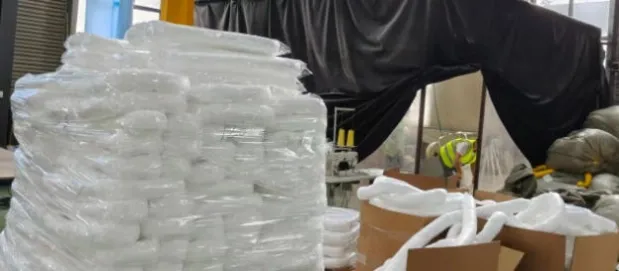
The photo above shows part of our daily production of oil absorbent socks.
As a manufacturer of spill control and absorbent products, we handle production in-house rather than simply sourcing finished products from different suppliers.
This gives us better control over:
- Material selection
- Product specifications
- Absorbent filling
- Dimensions and weight
- Packaging
- OEM and private-label requirements
- Production schedules and quality consistency
For distributors and industrial buyers, this means we can discuss product requirements directly with the factory and develop specifications according to the intended application.
Choosing the Right Oil Absorbent Sock
When sourcing oil absorbent socks, buyers should consider more than just the product price.
Important factors include:
Absorbency: How much oil can the sock absorb?
Dimensions: What length and diameter are suitable for the application?
Filling material: What type and quantity of absorbent material is used?
Outer sleeve: Is the sleeve strong enough for the intended handling conditions?
Application: Will the product be used indoors, outdoors, on land, or around water?
Packaging: Does the packaging suit storage, transportation, and distribution requirements?
For distributors, OEM buyers, and industrial users, consistent specifications from batch to batch are also important.
Looking for a Direct Manufacturer?
Oil absorbent socks may look like a simple product, but their performance depends on material selection, construction, and manufacturing quality.
We manufacture oil absorbent socks and other spill control products for distributors, industrial users, and OEM customers.
If you are sourcing oil absorbent socks for spill response, industrial safety, maintenance, or distribution, contact us to discuss your required specifications and application.
We can provide standard products as well as customized solutions for different markets and applications.