Blog
Spill Pallets: IBC vs Drum Containment — A Buyer's Guide
One leaking drum, one IBC on bare concrete — which spill pallet actually contains it? Sump sizes, load ratings and the 110% rule for drum and IBC storage.
A forklift driver walking the yard at first light spots it: a dark stain spreading from under a row of drums, already halfway to the storm drain. One drum took a knock the day before and its seam has been weeping oil all night. Beside the drums stand two 1000-litre IBCs of water-based additive, sitting on bare concrete like everything else in the yard. The crew stops the leak with pads and socks, but the real problem is underneath the containers — or rather, the lack of anything underneath them. Nothing was there to catch the leak in the first place.
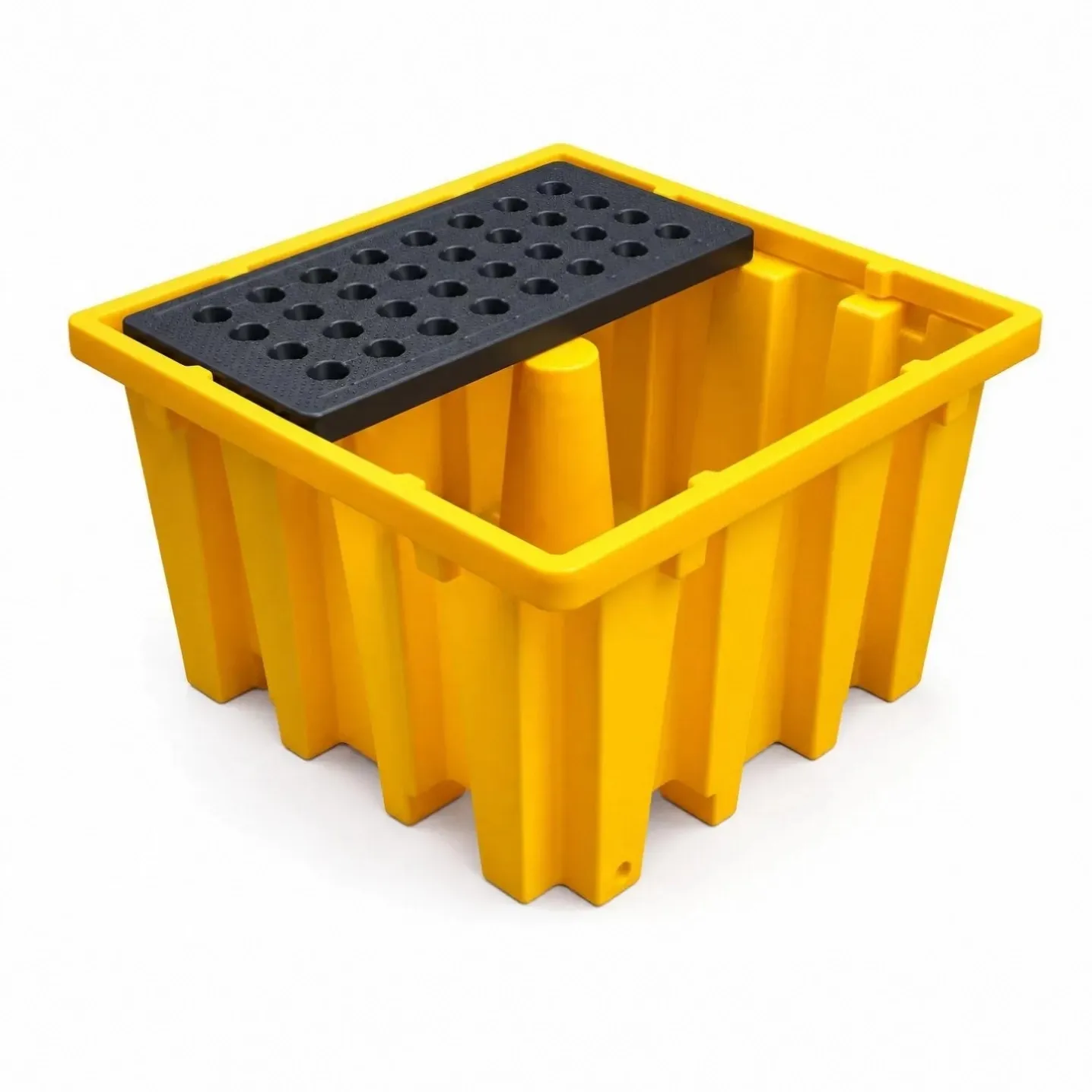
A spill pallet is a bunded platform that a drum or an IBC stands on: a tough tray with a raised rim and a sump underneath, so a leak, a drip or a split seam is caught in the tray instead of running across the yard. It is the cheapest secondary containment a storage yard can buy — and the most commonly bought wrong, because buyers size it to the container they have, not the spill it must hold.
What Does the 110% Rule Mean for a Spill Pallet?
The rule buyers use worldwide is simple: the sump should hold at least 110% of the largest single container standing on the pallet. A 205-litre drum needs a sump of at least 225 litres; a 1000-litre IBC needs at least 1100 litres. A pallet whose sump is smaller than that is not containment — it is a tray that overflows. Check the sump figure on the spec sheet before the price, because a pallet that cannot hold one full container is a pallet that fails on the day it matters.
How Much Can Each Pallet Actually Hold?
| 2-Drum Pallet | 4-Drum Pallet | 6-Drum Pallet | IBC Pallet |
|---|---|---|---|---|
Containers | 2 × 205 L drums | 4 × 205 L drums | 6 × 205 L drums | 1 × 1000 L IBC |
Sump capacity | 150 L | 230 L | 240 L | 1300 L |
Footprint | 1300 × 680 mm | 1300 × 1300 mm | 1900 × 1300 mm | 1350 × 1350 mm |
Height | 300 mm | 300 mm | 170 mm | 900 mm |
Forklift access | 2-way | 4-way | Yes | — |
Read the table against the 110% rule and the choice sharpens fast. The 4 Drum Spill Pallet (SCP-1313A) holds 230 litres — 110% of one 205-litre drum, exactly the level the rule asks for. The 2 Drum Spill Pallet (SCP-1368A) holds 150 litres, enough for leaks and drips from two drums but not a full drum failure — it is a dispensing and small-store pallet, not a full-containment one. The 6-drum pallet holds 240 litres across a whole row of six drums, and the IBC Spill Pallet holds 1300 litres, 130% of a standard 1000-litre IBC. Load ratings follow the same split: the drum pallets are rated 1300 kg uniformly distributed load (UDL) and 650 kg dynamic load (DLC), while the IBC pallet is rated 3600 kg UDL and 1300 kg DLC for a full IBC.
Which Pallet Goes Under Which Container?
Drums go on drum pallets and IBCs go on IBC pallets — mixing them up is the mistake that costs money twice. An IBC on a drum pallet overhangs the deck, overloads the load rating and spills over a sump sized for a drum. Drums on an IBC pallet sit 900 mm up in the air, where nobody can load them by hand, on a sump far bigger than the job needs. In a mixed yard, count both: the number of drum bays and the number of IBCs, and buy each type for its own containers. A yard that stores both and buys only one type has contained half its stock.
What About the Low-Profile 150 mm Pallets?
Where drums are loaded by hand, rolled on from a low trolley or stored under low racking, half the height makes the job easier — and Anwill's low-profile drum pallets stand 150 mm instead of 300 mm, on the same footprint. The trade-off is the sump: the 2-drum low-profile version holds 75 litres and the 4-drum version 115 litres, roughly half the standard sumps. That catches leaks and drips; it does not contain a full drum. Use the low-profile version where headroom or manual handling forces the choice, and keep the 300 mm version where full-drum containment is the requirement.
Four Checks Before You Order
First, size to the largest container in the bay, not the average spill — the 110% rule is about the worst case, not the usual one. Second, measure the bay: a 4-drum pallet needs a 1300 × 1300 mm square, and a 6-drum pallet a 1900 × 1300 mm rectangle, before the forklift has room to work around it. Third, check forklift access — 4-way access on the 4-drum pallet means it can be picked up loaded from any side, while 2-way access on the 2-drum pallet means the forklift must approach from the right direction. Fourth, plan for the sump itself: a pallet stored outdoors collects rainwater, and a sump full of rainwater holds no spill — in hot-climate yards, cover outdoor pallets or drain the sump after rain, and check the sump as part of the same routine that checks the drums.
Request a Quote
The leak in the yard at first light was a storage decision made months earlier, when the drums went onto bare concrete. Contact Anwill for a quotation or email [email protected]. Chengdu Anwill Technology Co., Ltd. (Anwill) is a spill control products supplier in China, with customers in over 40 countries — IBC spill pallets, 2-drum, 4-drum and 6-drum spill pallets, and low-profile 150 mm versions for tight storage bays.