APEC 2026 in Shenzhen: What Asia-Pacific Trade Growth Means for Spill Readiness
APEC 2026 meets in Shenzhen as Asia-Pacific trade grows. Busier ports, fuller warehouses and more fuel and chemicals in transit mean spill readiness has to work on the worst day, not the best.
It is 2 a.m. on a peak-season night shift at a container terminal. A forklift carrying a pallet of drummed chemicals clips a bollard on a turn, the pallet shifts, and one drum topples off the forks. The seam splits on the concrete. Liquid spreads fast across the yard — and the nearest storm drain is about fifteen metres away.
The night crew does not wait for the day shift. One worker wheels over the 120L spill kit parked beside the loading bay and pulls out absorbent socks to ring the spill. A second worker lays socks across the drain grate before the liquid gets there. A third calls the supervisor and starts logging what spilled, how much, and where it went. Within ten minutes the spread has stopped, the drain is protected, and the crew is picking up saturated pads into disposal bags. The drum goes into an overpack, the floor gets washed down, and the terminal is loading again before dawn.
Nothing about that night was unusual — except the volume. Peak season means more containers, more forklift movements, more drums handled per shift, and more chances for exactly this to happen. That is the part of trade growth nobody puts in a press release.
APEC week, and what it means for the yards and berths
This week the 33rd APEC Economic Leaders' Meeting takes place in Shenzhen, on 18–19 November 2026, under the theme "Building an Asia-Pacific Community to Prosper Together". Twenty-one economies are at the table, and the three priorities are openness, innovation and cooperation. The APEC CEO Summit runs alongside it on 17–18 November. It is the third time China has hosted the leaders' meeting, after 2001 and 2014.
Trade growth is good news for every port, warehouse and logistics yard in the region. It also means more of everything that can spill: more fuel transfers at berths, more chemical drums moving through warehouses, more trucks and forklifts working longer shifts. Spill readiness is the stock, the placement and the practice that let a crew contain a leak in the first ten minutes, before it reaches a drain, a berth or a waterway.
Many of the distributors and customers we work with sit in APEC economies — Australia, Japan, Singapore, the Philippines, Mexico, Chile and New Zealand among them. The absorbent pads, spill kits and booms we ship travel the same Pacific routes that this forum exists to keep open. When those routes get busier, the yards at both ends need to be ready for the worst day, not the best one.
Where does the extra risk actually sit?
More trade does not spread risk evenly. It concentrates in three places, and each one has a different answer.
| Pressure point | What changes as trade grows | What should already be in place |
|---|---|---|
| Fuel transfers at berths | More vessels, more hose connections, more chances for a drip to become a sheen | A containment boom at the berth and a 120L oil spill kit at each manifold |
| Forklift and drum handling in warehouses | More pallets moved per shift, more drum seams and valves under stress | Absorbent socks and pads within arm's reach of every loading bay |
| Fuel and chemical storage | Fuller tanks and racks, longer storage, more dispensing points | Spill pallets under drums and IBCs, plus a 660L kit as main stock |
The common thread is distance: a spill kit three minutes away is a different outcome from a spill kit thirty seconds away. At a busy terminal, the crew that contains a spill is the crew standing closest to the absorbent — so the stock has to sit where the work happens, not in a central store.
What should a busy terminal have in place before peak season?
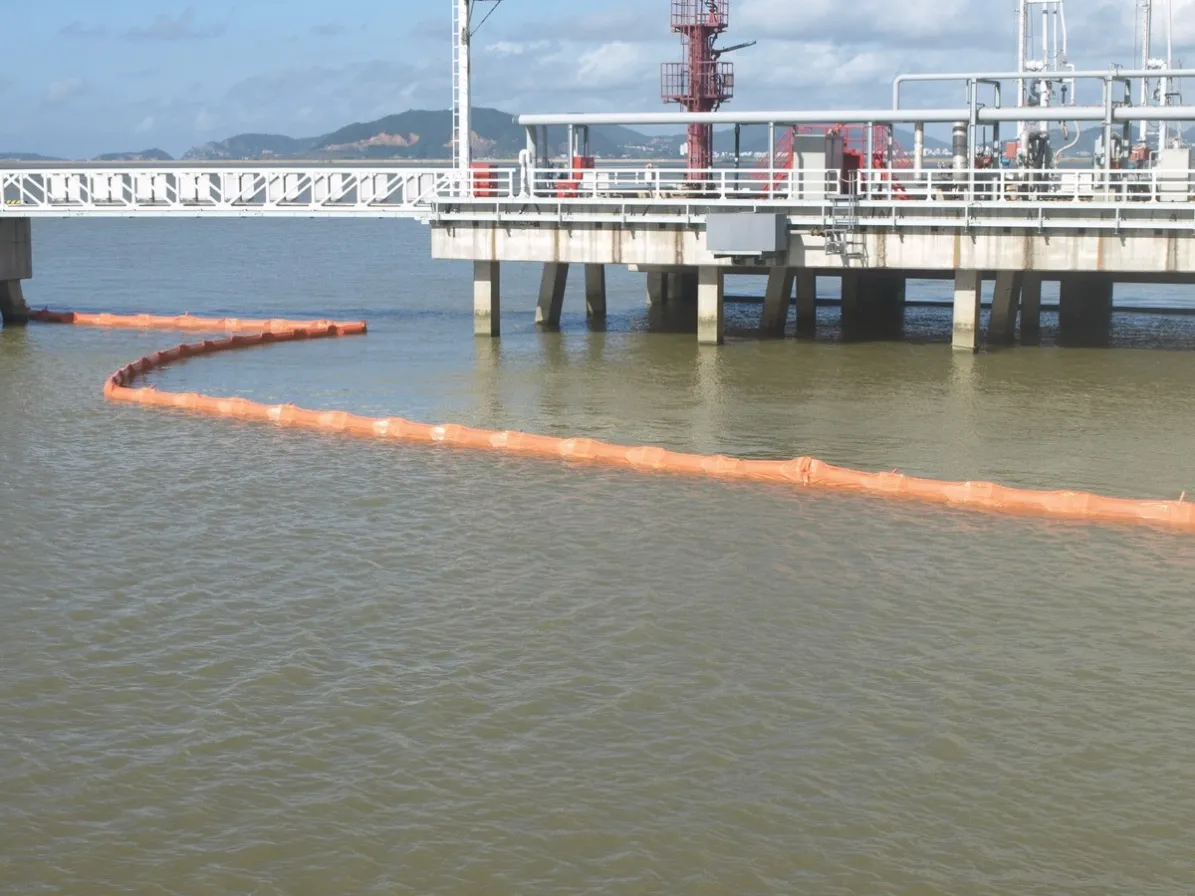
Start at the water. A berth that handles fuel transfers should keep sections of Eco-Friendly Oil Spill Containment Boom (WQV-500C) on a rack or in a trailer within a short walk of the manifold, with connectors and anchors in the same place. Each 10-metre section stands 500 mm tall in total — 160 mm of freeboard above the water and a 270 mm skirt below it — weighs about 20 kg and packs down to 0.2 cubic metres when deflated, so a working stock fits in a harbour store or a response trailer. For the full berth-side routine, see our guide on port oil transfer spill readiness.
Then the yard. A 120L Oil Spill Kit beside each transfer point or loading bay carries pads, socks, pillows and disposal bags for the recovery stage — the stage that starts the moment the boom is in place or the spread has stopped. A berth or warehouse that moves large volumes should keep a 660L Oil Spill Kit as its main stock and a 120L kit at each manifold or bay as the first-response unit.
Then the habit. A kit nobody has opened is not readiness. Before a peak season, walk the site with the night crew and check three things: every kit is full and its disposal bags are inside it, the boom connectors and anchors are with the boom rather than in a separate shed, and everyone on the shift knows where the nearest kit is without having to ask. That walk takes an hour. A spill that reaches a drain takes ten minutes to become a reportable incident. A kit beside a loading bay costs a fraction of one hour of berth downtime, one contractor call-out, or one fine — the expensive part of a spill is never the absorbent, it is the stopped work and the cleanup. Trade weeks like this one are the right moment to check: the drum that tips over at 2 a.m. will not wait for the day shift.
Request a Quote
Planning spill readiness for a port, terminal or warehouse? Contact Anwill for a quotation or email [email protected]. Chengdu Anwill Technology Co., Ltd. (Anwill) is a spill control products supplier in China, with customers in over 40 countries — inflatable PVC oil spill containment booms in 10-metre sections, oil spill kits from 20L to 660L, and absorbent pads, socks and pillows for the recovery stage.