Port Oil Transfer Spill Readiness: Booms and Kits Before the Hose Leaks
A hose coupling weeps fuel oil onto the water during a transfer at a port terminal — how much escapes before anyone notices, and what boom and kit stock a berth needs standing by.
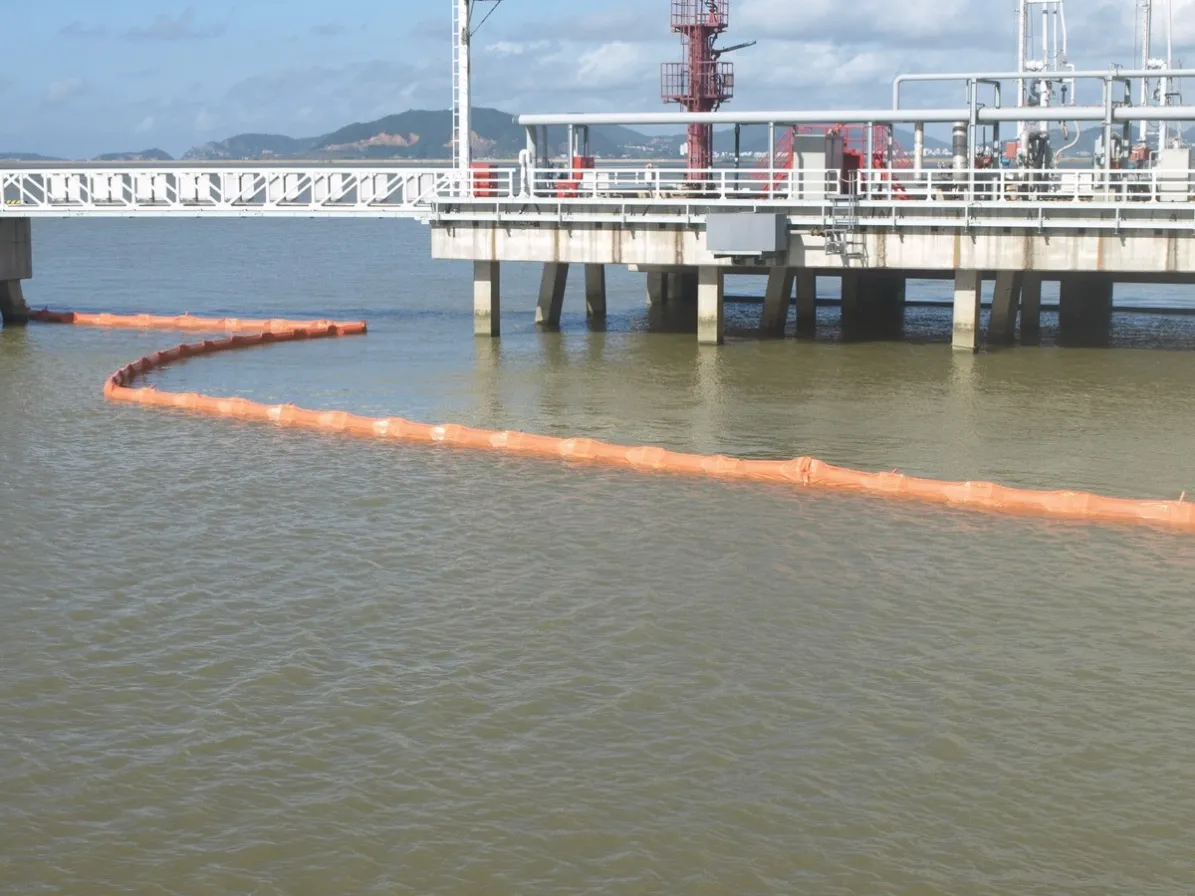
It is early morning at a container terminal, and a bunker barge is taking on fuel oil through a transfer hose. The pump has been running for twenty minutes when a deck hand spots it: a rainbow sheen on the water under the hose coupling, already stretching toward the next berth. The coupling is not broken — it is weeping, a thin stream the crew missed because the hose was over the water, not over the deck. The pump stops, but the oil does not. On water, a spill spreads in minutes, and a litre of oil can stretch into a sheen covering hundreds of square metres before anyone has walked to the store for a boom.
With Marintec Innovation 2026 opening in Shanghai on 3–4 December, ports and shipyards across the region are reviewing exactly this kind of readiness — not because a transfer is expected to fail, but because the one that does will not wait for equipment to be ordered. The same pressure is building on the trade side: as Asia-Pacific trade grows, busier terminals handle more fuel and chemicals per shift — see what APEC 2026 in Shenzhen means for spill readiness.
A port oil transfer spill is a leak of fuel or cargo oil into the water during loading, bunkering or discharge — and the response stock that matters is the boom and the spill kit already standing at the berth before the pump starts, not the equipment sitting in a warehouse across the port.
How Much Oil Escapes Before Anyone Notices?
More than the crew expects. A coupling that weeps at a rate nobody can see from the deck can put tens of litres on the water in the time it takes to walk the length of the jetty — and oil on water does not pool, it spreads. Wind and current carry the sheen, and in a tidal estuary the current reverses, so oil that drifted one way at the start of the transfer can come back past the berth an hour later.
That is why the first response is measured in minutes, not in phone calls. A terminal that keeps its boom on a rack a ten-minute walk from the berth has already lost the first ten minutes of the spill. The crew that stops a transfer spill fast is the crew that did not have to go looking for its equipment.
What Should Be Standing by Before the Transfer Starts?
Readiness at a transfer berth is a short, fixed list — checked before the pump starts, not after the sheen appears.
First, the boom. Sections of Eco-Friendly Oil Spill Containment Boom (WQV-500C) on a rack or in a trailer within a short walk of the manifold, with connectors and anchors in the same place. Each 10-metre section stands 500 mm tall in total — 160 mm of freeboard above the water and a 270 mm skirt below it — weighs about 20 kg and packs down to 0.2 cubic metres when deflated, so a working stock fits in a harbour store or a response trailer.
Second, the kit. A 120L Oil Spill Kit beside the transfer point, carrying pads, socks, pillows and disposal bags for the recovery stage — the stage that starts the moment the boom is in place. For a berth that handles transfers every day, a wheeled Mobile Spill Kit Cart Oil Only 120L (HZSC001-3) does the same job and moves with the crew.
Third, the plan, in one page on the berth: who stops the pump, who deploys the boom, who calls the port authority, and where the used absorbents go. Under MARPOL and China's marine environmental protection rules, ports handling oil must have an emergency response plan and equipment on site — the plan is only real if the crew at the berth knows it without looking it up.
How Do You Size the Boom and Kit for a Transfer Berth?
Size both to the largest spill the berth can realistically produce, not the average one. A practical rule of thumb used across the industry: the boom length needed is roughly three times the longest dimension of the area you want to enclose — a U-shaped deployment around a 10-metre-wide sheen takes about 30 metres of boom. Work it out before you order, because a 20-metre stock that cannot close the circle around a spill is money spent on a gap.
Current is the real limit on the water side. In calm water a boom holds oil well, but once the current against the boom passes roughly 0.7 knots, oil starts to escape underneath, no matter how good the boom is. In a tidal estuary or a river port, that means angling the boom across the current instead of laying it square to the flow — and it means checking the tide table before a transfer, not during one. In typhoon season, when a squall can arrive mid-transfer, the boom that is already deployed around the barge is the only one that counts.
On the kit side, the sizing question is simpler: how much oil can the absorbents in the kit pick up, and how fast can the crew get more? A 120L kit covers a small transfer leak; a berth that moves large volumes should keep a 660L Oil Spill Kit as its main stock and a 120L kit at each manifold as the first-response unit. Used absorbents go straight into the disposal bags in the kit — oil-soaked pads left on the jetty are a second spill waiting for the next rain.
Pre-Deployed Boom vs Boom on the Rack vs No Boom
| Pre-deployed around the barge | Boom on a rack near the berth | No boom on site | |
|---|---|---|---|
| First response time | Immediate — oil is inside the boom already | Minutes — crew deploys after the sheen is spotted | Hours — equipment must be called in |
| Oil contained | Most of the spill, at the source | Most, if the crew is fast and the current is low | Little — sheen spreads to other berths |
| Best for | Routine bunkering and transfers at a fixed berth | Occasional transfers, small terminals | Nothing — a berth that transfers oil should not be in this column |
Pre-deployment is the standard at the busiest bunkering berths for a reason: the boom costs the same whether it is in the water or on the rack, and in the water it is already working when the coupling weeps. The trade-off is maintenance — a boom left in the water needs regular checks for fouling and wear — but that is a scheduled job, not an emergency.
After the Transfer: Inspect, Restock, Repeat
Readiness is not a purchase, it is a routine. After every transfer, the crew checks the boom for damage, hoses it down, dries it, checks the valves and connectors, and repacks it. After every incident, the kit is restocked to full before the next transfer starts — a 120L kit with half its pads used is a 60L kit, and nobody re-labels it. The log is simple: date, transfer volume, any sheen seen, what was used, what was replaced. A berth whose log is up to date is a berth whose equipment is actually there when it is needed.
Request a Quote
The cheapest spill at a port terminal is the one that never leaves the boom. Contact Anwill for a quotation or email [email protected]. Chengdu Anwill Technology Co., Ltd. (Anwill) is a spill control products supplier in China, with customers in over 40 countries — inflatable PVC oil spill containment booms in 10-metre sections, oil spill kits from 20L to 660L, and wheeled spill kit carts for berths that transfer fuel every day.