How to Build a Spill Response Plan for Your Warehouse
A forklift clips a drum and 200 litres of oil is heading for the drain. What happens next depends on the plan you wrote last month. A practical warehouse spill response plan, step by step.
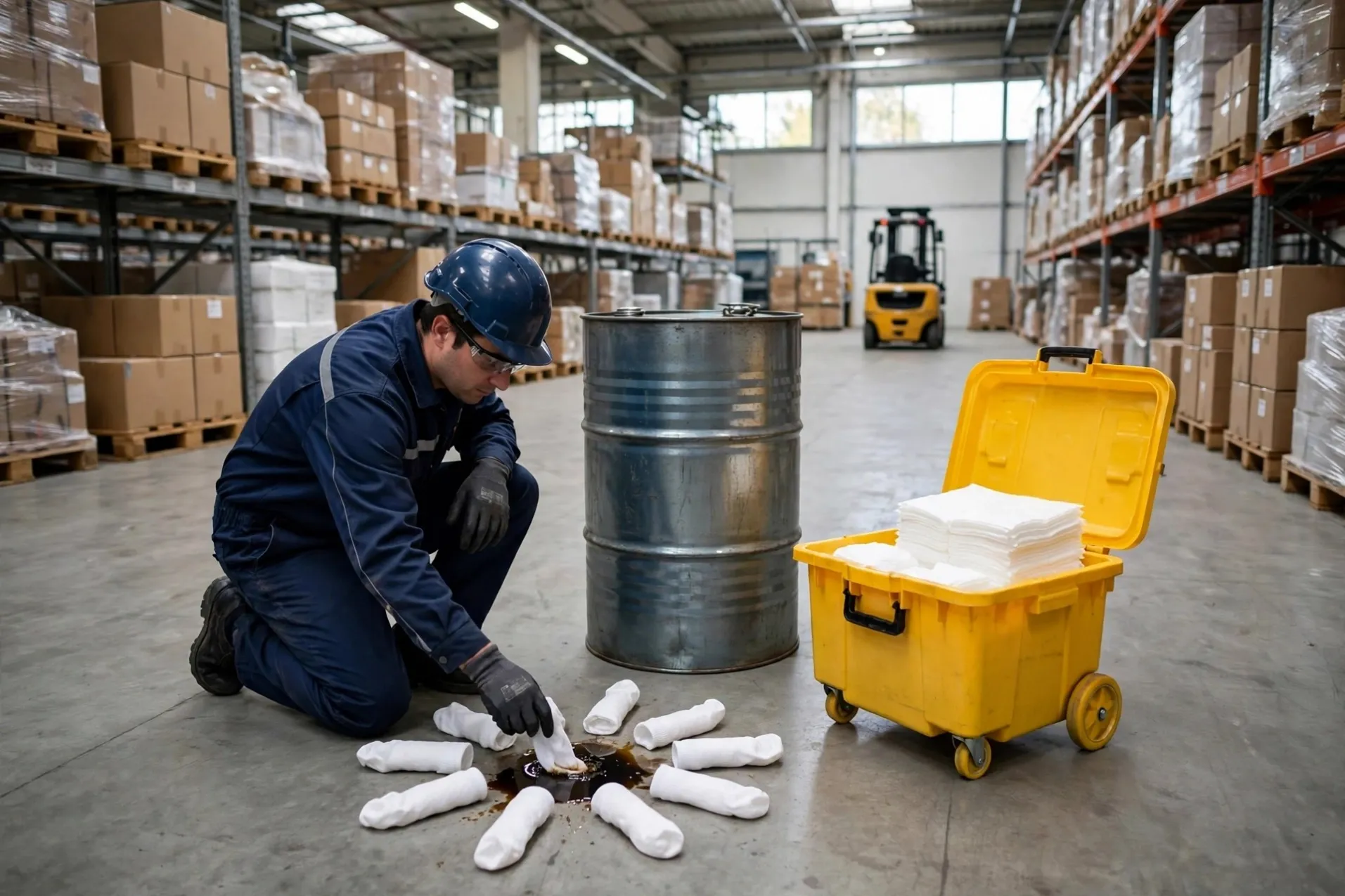
It is mid-morning at a distribution warehouse and a forklift turns too tight coming out of the racking aisle. The forks catch the side of a 205-litre drum of hydraulic oil, the seam splits, and oil starts running across the concrete toward the loading dock. The driver kills the engine and calls it in. One worker runs for the spill kit; another rings the spill with absorbent socks; a third stands at the dock door to keep the oil out of the stormwater drain. Twenty minutes later the floor is dry, the used absorbents are bagged, and the shift carries on. Nothing about that morning was luck — somebody had written down, before anything spilled, who does what, with which kit, and in what order, and the crew had practised it.
A warehouse spill response plan is a short written procedure that says who does what, with which spill kit, in the first 10 minutes after a liquid spill — and it is the difference between a 20-minute clean-up and a day of downtime, a fine, or a contaminated drain.
What Goes Wrong Without a Plan?
Without a plan, the same spill plays out very differently. Nobody is sure where the nearest kit is, so the first minutes are spent searching instead of containing. The oil reaches the drain because nobody was assigned to block it. Somebody grabs the wrong absorbents — universal pads on a chemical drum, or oil-only pads on a water-based liquid they will not touch. A warehouse without a written spill response plan does not have a spill problem; it has a decision problem. Under work health and safety duties in Australia and New Zealand, and the environmental protection duties that apply in both countries, a spill that reaches a drain or a waterway is not just a mess — it is a reportable incident.
How Do You Map the Spill Risks in Your Warehouse?
Start by walking the floor and marking every place liquid can escape. The loading dock is first: drums and IBCs are lifted, lowered and turned there, and a forklift strike is the single most common warehouse spill. Next is the drum store — a leaking seam, a drum knocked off a pallet, a tap left open on a dispensing drum — then the IBC bay, the battery-charging area and the waste-oil collection point. For each spot, write down three things: what liquid is there, how much could escape at once, and where it would run — which drain, which doorway, which slope in the floor. A plan built on that walk-through matches the warehouse you actually run; a plan copied from a template matches nobody's.
Which Spill Kit Goes Where?
One kit in the far corner of a warehouse is not a plan — it is a decoration. Size the kit to the largest single spill at each risk point, and put it within a 30-second walk of that point, visible and unobstructed.
| Location | Likely spill | Recommended kit |
|---|---|---|
| Loading dock | Forklift puncture, 205 L drum | 120L Oil Spill Kit |
| Drum store / dispensing bay | Leaking drum, tap left open | 50L Universal Spill Kit |
| IBC bay | IBC valve or seam failure | 660L Oil Spill Kit (wheelie-bin kit) |
| Office / small store | Small container knock-over | 20L Universal Spill Kit |
Match the kit type to the liquid, not just the size: oil-only kits for hydrocarbons, universal kits for mixed or unknown liquids, chemical kits where acids, alkalis or solvents are stored. Our guide to choosing the right spill kit size walks through the 20L, 50L, 120L and 660L range in detail. Where drums are stored, add secondary containment: a 4-drum spill pallet with a 230-litre sump holds 110% of one 205-litre drum, so a slow seam leak never reaches the floor.
Who Does What in the First 10 Minutes?
A plan that says "staff will respond" assigns the job to nobody. Name the roles, not just the tasks, and name a backup for each one. The first responder stops the source if it is safe to do so — upright the drum, close the valve — and rings the spill with absorbent socks. The second responder blocks the nearest drain with a drain cover and fetches the kit. The supervisor decides whether the spill is beyond the crew's gear, calls the external spill contractor if it is, and keeps everyone else out of the area. Every kit holds the same basics — pads, socks, pillows, disposal bags, gloves and goggles — so the plan can say "take the kit" instead of listing ten items under pressure. Write the first 10 minutes down as numbered steps, laminate the page, and fix it to the wall beside each kit.
How Often Should You Check and Drill the Plan?
A spill plan decays quietly: kits get raided for a small drip and never restocked, a new racking row blocks the path to the dock kit, a new starter never gets shown where the kits are. Check every kit monthly against its contents list and replace anything used or damaged. Run a short drill every quarter: spill a bucket of water in the dock area and time the crew containing it. If the drill takes longer than 10 minutes, the plan needs fixing, not the crew. Review the whole plan after any real spill and whenever the layout, the liquids stored or the team changes.
What Does the Plan Need to Say About Disposal?
Used absorbents are not general waste. A pad soaked in oil, solvent or chemical is contaminated waste, and the plan must say where it goes: into the disposal bags from the kit, sealed and labelled, and stored in the designated waste area until a licensed waste contractor collects it. Never hose a spill into a drain and never put used absorbents in a skip. The disposal step is the part most warehouse plans skip — and the part inspectors ask about first.
Request a Quote
The morning the forklift clips the drum is not the morning to start planning. Write the plan, place the kits, drill the crew — then the spill is a 20-minute interruption instead of a shutdown. Contact Anwill for a quotation or email [email protected]. Chengdu Anwill Technology Co., Ltd. (Anwill) is a spill control products supplier in China, with customers in over 40 countries — oil, universal and chemical spill kits in 20L–660L, absorbent socks and pads, and spill pallets for drum and IBC storage.