Blog
How to Choose the Right Spill Kit: 20L, 50L, 120L or 660L?
Spill kits come in 20L, 50L, 120L and 660L sizes — and in oil-only, chemical and universal types. Match the right kit to your spill risk, so you are ready when a leak happens.
A spill kit is only useful if it matches the spill it has to handle: too small and it runs out of absorbent halfway through the clean-up; too large and it wastes money and storage space. Choosing the right one comes down to three questions: what liquid could spill, how much of it, and where it could happen.
Start With the Spill, Not the Kit
Before looking at sizes, map the risk in your workplace:
- What liquid? Oil and fuel, aggressive chemicals, or a mix of oil, water and coolants? The liquid decides the absorbent type (see below).
- How much? Look at the largest single container in the area — a 20-litre drum, a 200-litre drum, an IBC or a fuel tank. Your kit should be able to absorb at least that volume.
- Where? A spill in a vehicle, a workshop bench, a warehouse aisle or a loading dock each needs a different kit — portable for the vehicle, wheeled for the warehouse.
The Four Sizes at a Glance
Anwill spill kits come in four capacities, each in three absorbent types — oil-only, chemical and universal — so there are twelve combinations in total:
Kit size | Best for | Container | Example contents (oil version) |
|---|---|---|---|
Small leaks and drips | Portable bag | 15 pads, 2 socks, gloves, goggles, disposal bags | |
Workshop spills and vehicle leaks | Portable bag | 40 pads, 2 socks, 2 pillows, gloves, goggles, disposal bags | |
Drum spills and warehouse incidents | Wheeled bin, 49 × 54 × 92 cm | 75 pads, 4 socks, 5 pillows, gloves, goggles, disposal bags | |
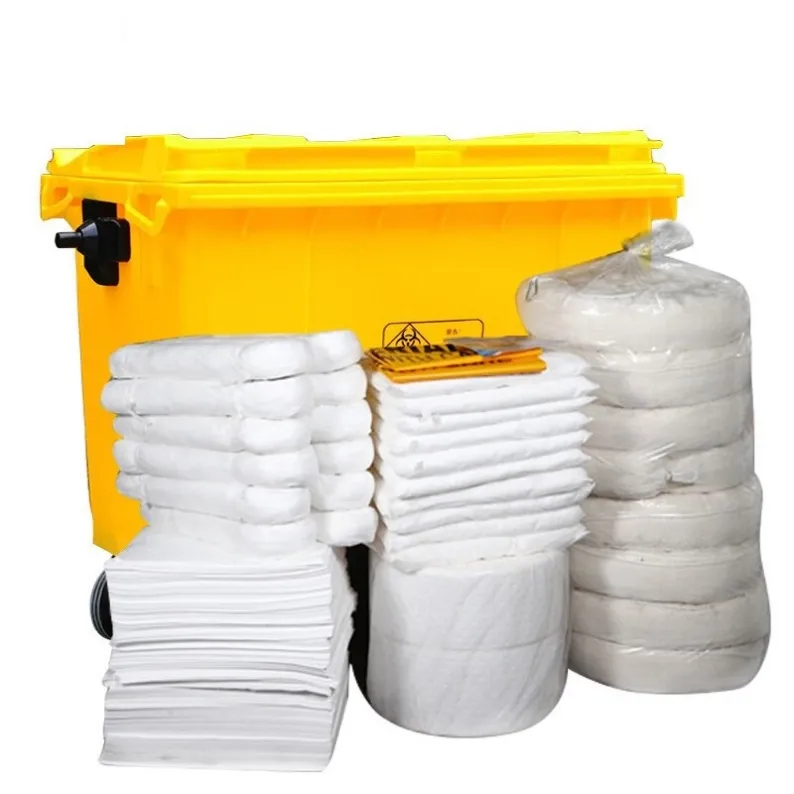
Major spills and large sites | Yellow wheeled bin, 125.5 × 77 × 120 cm | 200 pads, 35 socks, 2 booms, 15 pillows, 1 roll, gloves, goggles, disposal bags |
20L Kit — Grab-and-Go for Small Leaks
The 20L kit is the most portable in the range. Packed in a lightweight bag, it is made for the small, everyday leak: a dripping hose, a knocked-over container, a few litres of oil on a workshop floor. Keep one in a vehicle, a garage or beside a machine, so help is at hand the moment a leak is spotted. The oil version contains 15 pads (50 × 40 cm × 2 mm), 2 socks, disposal bags, gloves, goggles and an instruction sheet.
50L Kit — The Workshop Standard
The 50L kit is the workhorse for workshops, fuel stations and small storage areas. It handles a spill from a 25- or 50-litre container and still fits in a portable bag (50 × 40 × 25 cm) that one person can carry. The oil version contains 40 pads (40 × 50 cm × 3 mm), 2 socks, 2 pillows for pooling liquid, disposal bags, gloves, goggles and an emergency guide.
120L Kit — For Drum Spills and Warehouses
When 200-litre drums, IBCs or fuel tanks are on site, a 50L kit is not enough. The 120L kit comes in a wheeled bin that rolls straight to the spill and doubles as storage between incidents. The oil version holds 75 pads, 4 socks, 5 pillows, disposal bags, gloves, goggles and an instruction sheet — enough absorbent to deal with a substantial drum leak. It is the standard choice for warehouses, workshops, fuel stations, ports and transport depots.
660L Kit — Full-Scale Cover for Large Sites
The 660L kit is the largest in the range, built for major spills and large industrial sites. Its yellow wheeled bin is easy to spot in an emergency, and inside it are 200 pads, 35 socks, 2 absorbent booms to surround a large spill, 15 pillows, a roll of absorbent for spreading liquid, 20 disposal bags, 6 pairs of gloves, 6 pairs of goggles and an emergency guide.
Oil-Only, Chemical or Universal — Which Type?
Size is only half the choice. The absorbent type matters just as much:
- Oil-only — hydrophobic absorbents that take up oil and fuel while repelling water — the right choice for hydrocarbons, including spills on water.
Chemical — made for aggressive chemicals and acids; the bright yellow absorbents are easy to identify in an emergency.
Universal — absorbs oil, water, coolants and most other liquids — the choice when the spill could be almost anything, or when you want one kit type for the whole site.
If you are unsure which liquid you are dealing with, choose universal — it covers the widest range. For oil and fuel only, oil-only absorbents are the most effective, because they will not waste capacity soaking up rainwater.
How Many Kits Do You Need?
One kit is rarely enough for a whole site. A practical approach is:
- One kit per risk area — beside each drum store, fuel point, loading dock and workshop.
- One portable kit per vehicle — a 20L or 50L bag travels with the truck or forklift.
- One large kit at the main storage area — a 120L or 660L wheeled bin where bulk liquids are kept.
Check kits regularly: the bag or bin should be sealed, contents complete, and gloves and goggles in date. A partly used kit that was never refilled is no better than no kit at all.
Request a Quote
Tell us what you store and how much, and we can recommend the right size and type — and supply custom kits with your own contents, logo and packaging on request. Contact us for a quotation — or email [email protected]. Anwill has manufactured spill control products in China since 2009, serving customers in over 40 countries.