Oil Spill Containment Booms: How They Work on Water
A hose coupling leaks diesel onto the water at a fuel transfer — how does a containment boom stop it spreading? How booms work, how fast a crew can deploy one, and what size a small terminal needs.
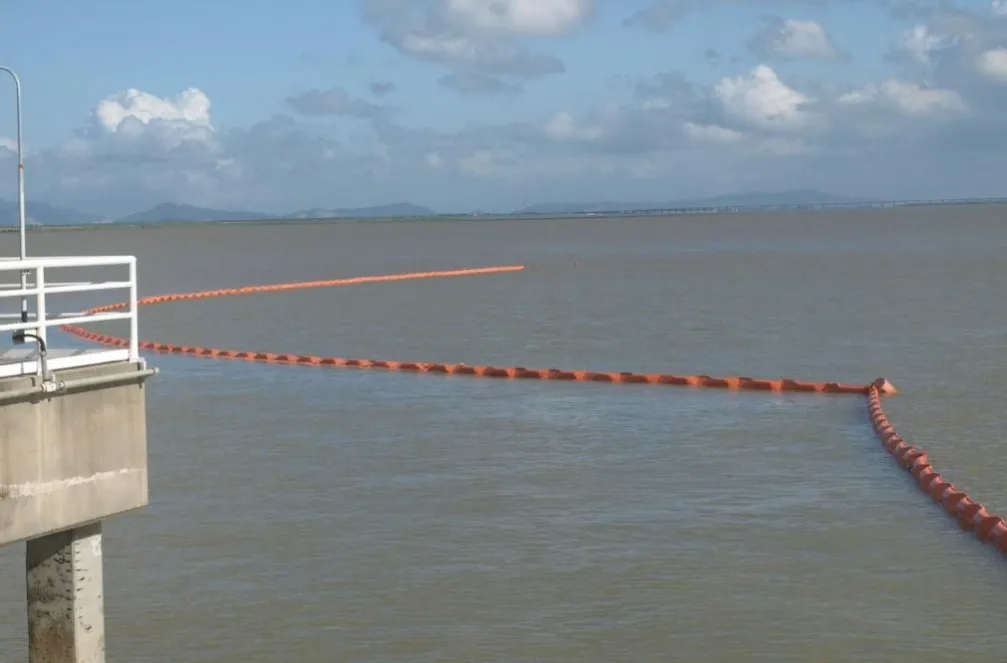
It is just after dawn at a small fuel terminal, and a transfer hose is moving diesel from a storage tank to a barge. Halfway through the transfer, a coupling starts weeping. Nobody notices for a few minutes — then someone spots the sheen on the water, rainbow-coloured, already drifting toward the neighbouring berth. The pump is stopped, but the diesel keeps spreading. On water, a spill does not sit still the way it does on concrete: wind and current carry it, and every minute it covers more surface.
The crew's first move is not a mop or a pad. It is the boom rack.
An oil spill containment boom is a floating barrier that sits on the water's surface and corrals spilled oil into one patch so it can be recovered instead of spreading. It works the same way a fence works on land, except the fence floats: part of it rides above the water to block oil drifting across the surface, and part of it hangs below the waterline to stop oil slipping underneath. A boom does not absorb oil and it does not remove it — it buys the crew time and a defined area to work in.
How Does a Boom Hold Oil on Water?
A boom has two working parts. The freeboard is the section above the waterline — it stops wind-blown oil and small waves from washing over the top. The skirt, or draft, hangs below the waterline and blocks oil from passing underneath. The balance between the two decides whether the boom works or fails: too little freeboard and oil splashes over in a chop; too little skirt and the oil ducks under it, especially when the current picks up.
Take Anwill's inflatable PVC boom, model WQV-500C, as an example of the proportions involved: each 10-metre (33 ft) section stands 500 mm (about 20 in) tall in total, with 160 mm (about 6 in) of freeboard above the water and a 270 mm (about 11 in) skirt below it. A galvanised ballast chain — 2 kg per metre — runs along the bottom of the skirt to keep the boom upright and add tensile strength. Those numbers are the product's own specification; the principle applies to any boom of this type.
Current is the real limit. In calm water a boom holds oil well, but once the current against the boom passes roughly 0.7 knots, oil starts to escape underneath, no matter how good the boom is. That is why crews angle the boom across the current instead of laying it square to the flow, and why towing a boom must stay slow — under 1 knot — or the oil washes straight through it. A boom that is dragged fast is worse than no boom at all, because it looks like the spill is contained when it is not.
How Fast Can a Crew Deploy a Boom?
At the terminal, the crew pulls sections off the rack, inflates the chambers, and clips them together. Inflatable boom sections connect with screw or hinged quick connectors that join in seconds with no tools, and each 10-metre section of the WQV-500C weighs about 20 kg (44 lb) and packs down to 0.2 cubic metres (about 7 cu ft) when deflated — so a working stock fits in a van, a harbour store, or the corner of a warehouse. That matters, because a boom that is still in its packaging on the far side of the yard is no use when diesel is already on the water.
Deployment follows a fixed order. First, work out which way the oil is drifting — watch the sheen, not the wind gauge — and set the boom across its path, not behind it. Second, link the sections into a U shape around the spill, with the open end facing upstream, so the current pushes oil into the pocket instead of around the ends. Third, anchor or tie off both ends so the boom cannot drift away with the oil inside it. Only then does the crew start recovery: skimming the pooled oil off the surface, or laying absorbent pads and socks inside the boom to soak it up.
Inflatable Boom vs Foam-Filled Boom
| Inflatable PVC boom | Foam-filled boom | |
|---|---|---|
| Storage | Deflates and packs flat — a 10 m section packs to 0.2 m³ | Holds its shape — needs far more storage space |
| Weight (10 m section) | ~20 kg (44 lb) | Heavier — foam core plus fabric |
| Deployment | Inflate, then connect — a few minutes per section | Unroll and connect — no inflation step |
| Best for | Terminals, marinas and response trailers that store boom between incidents | Permanent deployment at a fixed berth or outfall |
Foam-filled boom is faster to put in the water because there is nothing to inflate, but it takes up so much storage that most small terminals cannot keep a useful length on hand. Inflatable boom trades a few minutes of inflation for a stock that actually fits in the store — and a stock that fits is a stock that gets deployed.
What Size Boom Does a Small Terminal Need?
Buy enough boom to encircle the largest spill your site can realistically produce, with margin. A practical rule of thumb used across the industry: the boom length you need is roughly three times the longest dimension of the area you want to enclose — a U-shaped deployment around a 10-metre-wide sheen takes about 30 metres of boom. Work it out before you order, because a 20-metre stock that cannot close the circle around a spill is money spent on a gap.
Under the US EPA's Spill Prevention, Control, and Countermeasure (SPCC) rule, facilities that store oil must have a spill prevention plan and secondary containment sized to the largest single container — the same thinking applies on the water side: the boom, the absorbent stock and the response plan should all be sized to your biggest credible spill, not your average one. A terminal that transfers 5,000 gallons at a time needs a very different response stock from a marina that fuels boats one at a time.
Store the boom where the spill will happen, not where it is tidy. The sections should sit on a rack or in a trailer within a short walk of the transfer point, with the connectors, anchors and a few absorbent socks in the same place. After each use, hose the boom down, dry it, check the valves and connectors, and repack it — a valve that sticks or a connector that will not seat is found during inspection, not during the next spill.
What Happens After the Boom Is In Place
The boom contains the oil; it does not clean it up. Once the sheen is corralled, the crew recovers it — skimming the thicker oil off the surface, then using oil absorbent booms and pads inside the contained area to pick up what is left. Keep a 120L Oil Spill Kit beside the transfer point — it carries pads, socks, pillows and disposal bags for the recovery stage. For a berth or outfall where oil on water is a recurring risk, keep a dedicated stock of the Eco-Friendly Oil Spill Containment Boom (WQV-500C) on site, sized to the area you need to enclose, so the first response is minutes away instead of a phone call away. As Asia-Pacific trade grows, busier terminals move more fuel and chemicals per shift — see how Asia-Pacific trade growth raises the stakes for spill readiness.
Request a Quote
A boom on the rack is cheaper than a spill that reaches the next berth. Contact Anwill for a quotation or email [email protected]. Chengdu Anwill Technology Co., Ltd. (Anwill) is a spill control products supplier in China, with customers in over 40 countries — inflatable PVC oil spill containment booms are available in 10-metre sections with screw or hinged connectors, in standard and custom lengths to fit your terminal, marina or harbour.