PPE for Spill Cleanup: Gloves, Goggles and Protective Clothing
Bare hands on a chemical spill is how a small leak becomes an injury. The gloves, goggles and coveralls to wear before you touch it — matched to the liquid, not grabbed at random.
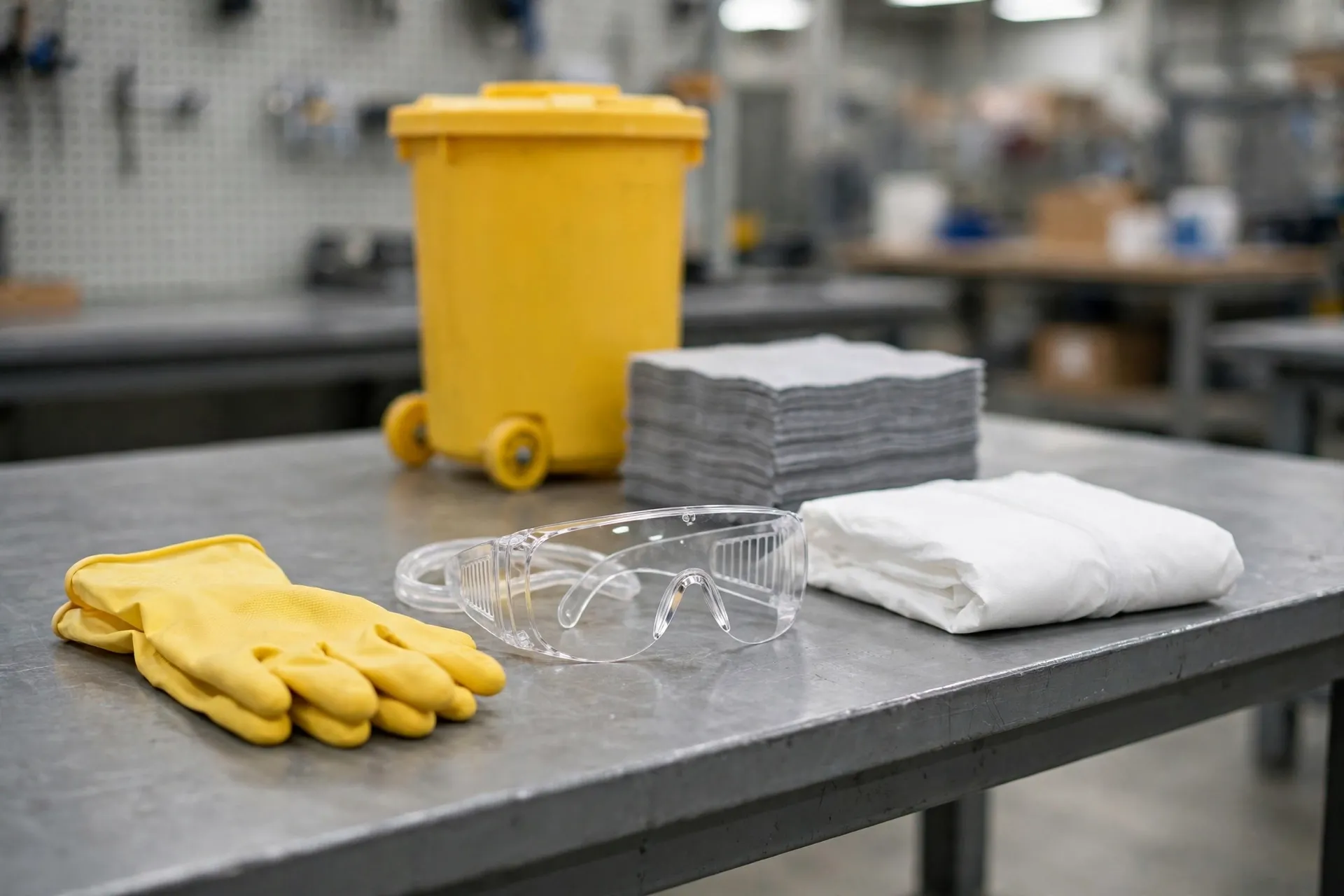
A drum of water-based cleaning chemical has tipped off a stillage in the chemical store, and a dark pool is spreading toward the doorway. The first person on the scene does what most people do: grabs a handful of absorbent pads and kneels straight into it, bare-handed, in a short-sleeved shirt. The pads work. The cleanup takes ten minutes. The skin irritation on both forearms takes a week to settle — and the safety data sheet, read afterwards, says plainly that the liquid causes skin irritation and that gloves and eye protection are required for handling.
PPE for spill cleanup is the gloves, goggles and protective clothing worn before anyone touches a spilled liquid — the barrier between the responder and the chemical, not an accessory to the absorbents. It is put on before the first pad comes out of the kit, because the moment a responder is already kneeling in a spill is the moment it is too late to go and find it.
Why Does the Liquid Decide the Glove?
No single glove material resists every chemical, and the wrong glove is worse than it looks: a glove that the liquid permeates gives the wearer false confidence while the chemical reaches the skin. The right choice starts with the safety data sheet — Section 8 names the glove material the chemical's maker recommends — and with the breakthrough time, the minutes a glove holds out before the chemical passes through it. Under the European EN 374 standard, gloves are rated by permeation class: Class 1 holds out for more than 10 minutes, Class 6 for more than 480 minutes. A glove rated for a 10-minute splash is not a glove for a 30-minute cleanup.
| Glove material | Handles well | Struggles with |
|---|---|---|
| Nitrile | Oils, greases, many solvents, most water-based chemicals | Ketones, aromatic solvents |
| PVC | Acids, alkalis, alcohols, water-based liquids | Many organic solvents |
| Butyl rubber | Ketones, esters, strong acids | Oils and hydrocarbons |
| Natural rubber latex | Water-based liquids, dilute acids | Oils, solvents; latex allergy is a real risk for some wearers |
This table is general industry guidance for choosing a glove family — always confirm the exact chemical against the glove maker's permeation chart and the SDS before relying on it. Two practical rules cover most mistakes: never use latex gloves on an oil spill, and never reuse a disposable glove that has been in contact with a chemical — it goes in the disposal bag with the used absorbents.
Are Safety Glasses Enough, or Do You Need Goggles?
Safety glasses protect against a flying particle. They do not protect against a splash, because a splash comes from below and from the sides, through the gaps around the frame. Any spill that can splash — a drum tipping, a pressurised line, a pad being wrung out — calls for sealed goggles with indirect ventilation, rated to EN 166 in Europe. The indirect vents let air in while blocking liquid, so the lens does not fog as fast and the seal stays against the face. Goggles go on before the gloves, because a responder who has already handled contaminated pads should not be touching their face to fit eye protection.
Eyes get a second layer of protection that is easy to forget until it is needed: an eyewash point. Where chemicals are handled, a gravity-fed eyewash station belongs within a short walk of the work — the Portable Eyewash Station (WJH0982A) holds 8 gallons of clean water, and pulling down the front tray starts twin spray heads that keep flowing hands-free, so both hands stay free to hold the eyes open. Fifteen minutes of flushing is the standard first-aid advice for a chemical splash in the eye, and that only works if the water is already there when the splash happens.
What About Coveralls and Footwear?
Coveralls stop the spill from soaking through a shirt and sitting against skin for the length of the cleanup. For most workshop and warehouse spills, a disposable coverall rated for liquid splash (Type 6 under EN 13034) is enough; where the liquid is a strong chemical or the spill is large, a liquid-tight suit (Type 3 or Type 4 under EN 14605) is the right call. The test is simple: if the liquid would soak through normal work clothes, the responder needs a barrier layer over them. Footwear matters the same way — chemical-resistant boots or overshoes, not fabric trainers, because a pool on the floor reaches shoes first.
The order of putting it on matters, and it is the same every time: coveralls first, then goggles, then gloves last, with the glove cuffs pulled over the coverall sleeves so there is no gap at the wrist. Taking it off is the reverse, and it is where most contamination actually happens: peel the gloves off without touching the outside with bare skin, roll the coveralls down inside-out, and wash hands immediately — even if the gloves looked intact.
How Much PPE Does a Spill Kit Need?
A kit's PPE stock is sized to its crew, not to its absorbent capacity. A 20L Chemical Spill Kit carries one pair of protective gloves and one pair of goggles — enough for the one person who finds the leak first. A 120L Chemical Spill Kit carries two pairs of each, and the 660L kit carries six pairs of each, because a large spill is a two- or three-person job and nobody should be waiting for a spare pair while a pool spreads. The rule for any site is the same as the rule for absorbents: a kit with its PPE already used up is a kit that is not ready, and the gloves and goggles are restocked at the same time as the pads — not "next month".
Storing the PPE is part of the same discipline. Gloves, goggles and coveralls live with the kit, not in a separate cupboard down the corridor: in the kit bin, or on the shelf directly above it, where the responder's hands go first. Gloves degrade in heat and sunlight, goggles scratch, and coveralls tear — check them on the same schedule as the kit itself, and replace anything stiff, sticky, cracked or past its date. For the inspection routine that covers this, see what to do in the first 10 minutes of a chemical spill.
Request a Quote
The cheapest injury in a chemical store is the one that never happens. Contact Anwill for a quotation or email [email protected]. Chengdu Anwill Technology Co., Ltd. (Anwill) is a spill control products supplier in China, with customers in over 40 countries — chemical spill kits from 20L to 660L with gloves, goggles and disposal bags included, chemical absorbent pads, socks and pillows, and portable eyewash stations for the areas where chemicals are handled.