Blog
Chemical Spill Response: What to Do in the First 10 Minutes
A drum tips over in a chemical store and liquid runs for the floor drain — the first ten minutes decide whether it stays a cleanup or becomes an incident report.
A forklift turns too tight in a chemical store and clips a 200-litre drum standing near the aisle. The drum rocks, tips off its pallet and splits at the seam. Solvent-based cleaning chemical pours across the concrete, running in a thin sheet toward the floor drain at the far wall. The driver kills the engine. What happens in the next ten minutes decides whether this is a cleanup or an incident report.
Minute 0–2: Stop, Look, Decide Whether to Stay
The first two minutes are for assessment, not for grabbing pads. A chemical spill is not an oil spill: the liquid may be corrosive, flammable, toxic by inhalation, or all three, and the label on the drum and the safety data sheet (SDS) are the only reliable guides. If the liquid is unknown, if the room fills with vapour, or if anyone feels dizzy, irritated eyes or a burning throat, the answer is to leave, close the door, raise the alarm and call the site emergency team — a chemical spill that sends a responder to hospital is a failed response.
If the chemical is identified, the vapour is low and the spill is small enough for the trained first responders on site, the response starts now. Open the ventilation if the site procedure allows it, and keep everyone else out of the room. In the EU, chemical stores and process areas operate under CLP labelling and REACH rules, and sites holding larger quantities fall under Seveso III major-accident duties — but on the floor, in the first minutes, one question matters most: do we know what this liquid is, and does the SDS say our kit can handle it?
What PPE Do You Put On First?
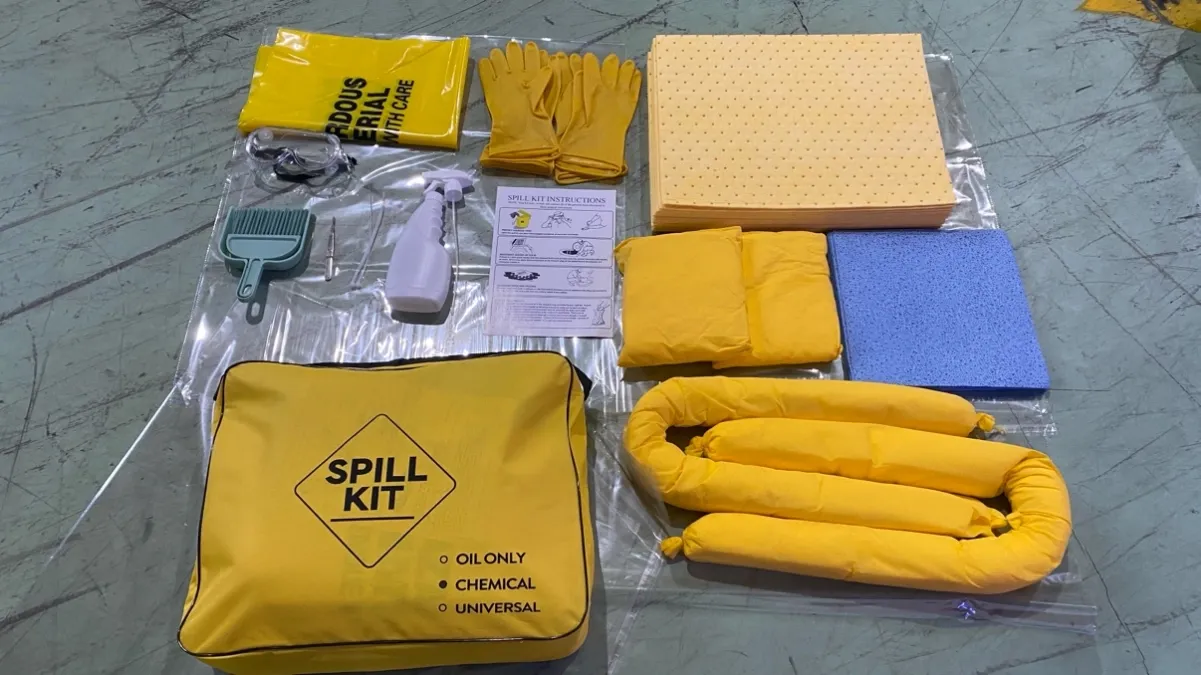
Gloves and goggles before absorbents — that order is not optional. The 120L Chemical Kit carries two pairs of protective gloves and two pairs of protective goggles for exactly this reason: the responder suits up from the kit itself, without walking to another store. Check the SDS for the glove material the chemical needs — a glove that resists oil may not resist a solvent — and if the SDS calls for a respirator or a face shield, the kit's goggles are not a substitute.
Minute 2–5: Contain It Before You Clean It
Containment comes before absorption, because a contained spill is a small spill and an uncontained one is a spreading one. Lay chemical absorbent socks around the edge of the liquid to ring it in — Ø 7.6 cm × 1.2 m socks bend around a drum base or a rack leg, and they buy time while the rest of the kit is opened. Protect the drain first: if there is a drain cover or a spare sock within reach, block the drain before the liquid reaches it, because liquid that enters a drain is no longer a spill, it is a watercourse pollution incident.
Yellow chemical absorbents are colour-coded for a reason, and it is not decoration. Yellow means the absorbent is built for hazardous liquids; white oil-only pads are designed to repel water and pick up hydrocarbons, and they are the wrong tool for an aggressive chemical. Grabbing the nearest pad without checking the colour is the most common mistake in chemical spill response — a 120L chemical kit holds bright yellow pads, socks and pillows so the right kit is obvious at a glance, even in a hurry.
Minute 5–10: Absorb, Bag, and Report
Once the spill is ringed in, work from the outside edge inward. Lay chemical absorbent pads over the liquid — 40 × 50 cm pads, 3 mm thick, in the 120L kit — and let them take up the chemical rather than pushing the liquid around with them. Pillows (40 × 50 cm) go on the deepest pools, where a pad would saturate in seconds. A 120L chemical kit is sized for spills up to 120 litres, so a drum that lost half its contents before anyone noticed will use most of one kit — that is what the kit is for, and a half-empty kit should never be put back on the shelf as if it were full.
Used absorbents go straight into the disposal bags in the kit — six bags with ties in the 120L kit — and the bags are tied, labelled with the chemical name, and set aside for hazardous waste collection. Chemical-soaked pads left in an open bin keep giving off vapour; bagging them is part of the cleanup, not the tidying-up afterwards. Then the incident gets written down: what spilled, how much, what was used, who responded, and what needs restocking. In many EU workplaces the spill report is a legal record, and the restock order goes out the same day — a chemical store whose kit was used yesterday and not replaced is a store with no kit at all.
Which Kit Belongs Where?
| 20L Chemical Kit | 120L Chemical Kit |
|---|---|---|
Absorbency | Up to 20 litres | Up to 120 litres |
Pads | 15 pcs, 50 × 40 cm × 2 mm | 75 pcs, 40 × 50 cm × 3 mm |
Socks | 2 pcs, Ø 7.6 cm × 1.2 m | 4 pcs, Ø 7.6 cm × 1.2 m |
Pillows | — | 5 pcs, 40 × 50 cm |
Gloves / goggles | 1 pair each | 2 pairs each |
Container | 20L carry bag | 120L wheeled bin, 49 × 54 × 92 cm |
Best for | Laboratory bench, vehicle, small chemical store | Chemical store, process area, warehouse aisle |
A small 20L Chemical Kit in a carry bag belongs where a spill would be small and the responder is one person — a laboratory, a service vehicle, a bench. The 120L kit in its wheeled bin belongs where a drum can fall: the chemical store, the process area, the warehouse aisle. Size the kit to the largest container in the room, not the average spill. A store that holds 200-litre drums and stocks only a 20L kit has planned for a leak, not a drum.
After the Ten Minutes: Restock Before the Next Drum Falls
The response is not finished when the floor is dry. The kit is checked, the used contents are counted, and the missing pads, socks, bags and gloves are ordered the same day. A kit that is missing its socks cannot contain the next spill, and a kit that is missing its goggles cannot protect the next responder. The store gets a second look too: was the drum on a spill pallet, was the aisle wide enough for the forklift, was the drain covered? Most chemical spills are not bad luck — they are a storage layout that finally ran out of luck.
Request a Quote
The first ten minutes of a chemical spill are decided by the kit that is already in the room. Contact Anwill for a quotation or email [email protected]. Chengdu Anwill Technology Co., Ltd. (Anwill) is a spill control products supplier in China, with customers in over 40 countries — chemical spill kits from 20L to 660L, yellow chemical absorbent pads, socks and pillows, and hazardous waste disposal bags for the cleanup that follows.