Secondary Containment Upgrades: How Better Storage Stops Pollution Before It Starts
A slow drip overnight can reach the drain by morning. How to size secondary containment — spill pallets, berms and bunds — so storage leaks stop at the sump.
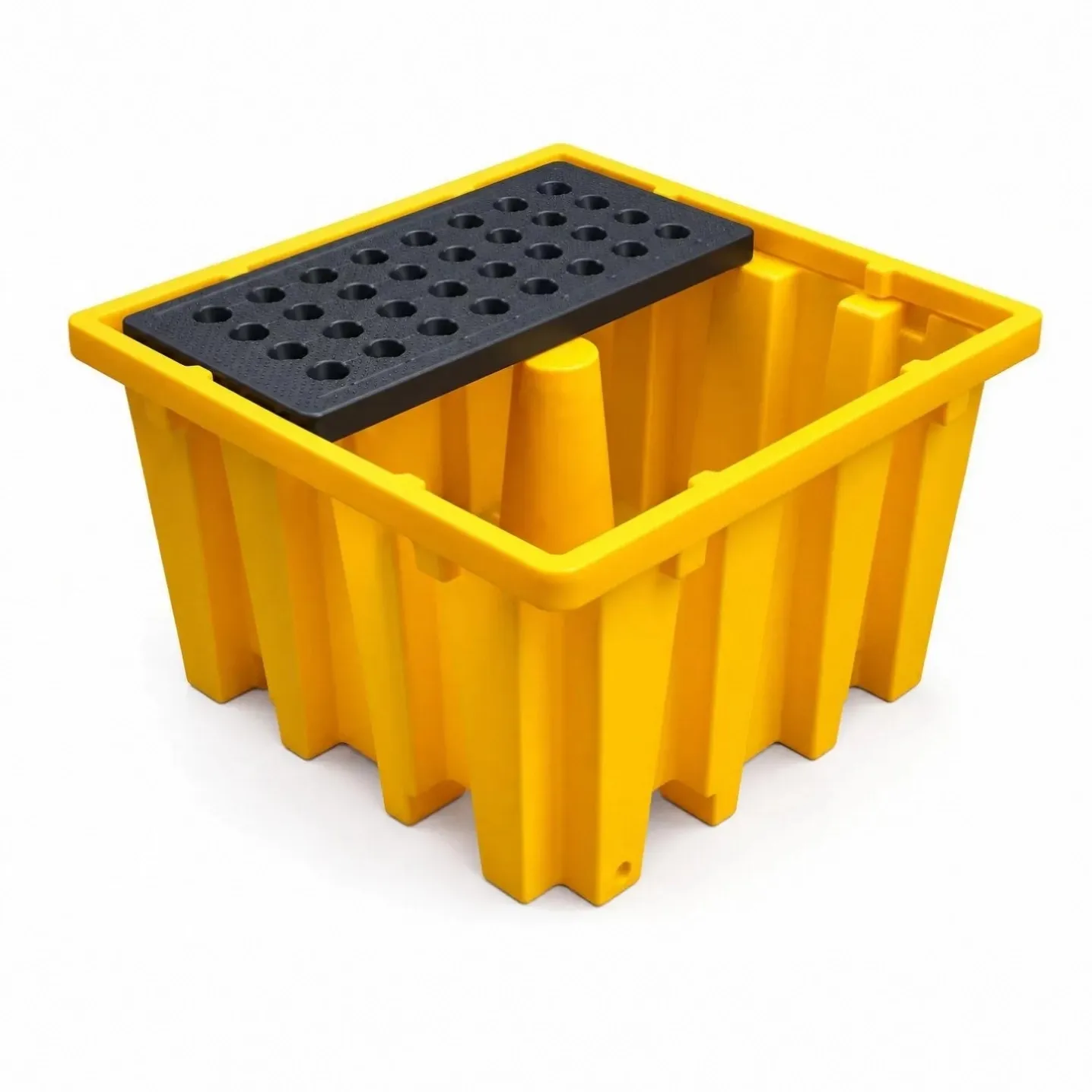
The leak was found at the morning walk-round: a dark sheen spreading from under an IBC toward the yard drain, and a tap that had been weeping since the previous afternoon's decanting. Nothing had burst. No forklift had hit anything. A valve seal had simply given up overnight, and because the IBC stood on bare concrete, roughly a bucketful of product had all night to travel. The clean-up took two people most of the morning, the drain had to be checked, and the incident report asked the question that matters: why was a thousand litres of liquid stored with nothing underneath it?
Secondary containment is a bunded barrier or sump placed around stored liquids so that the full contents of a leak are caught before they can reach soil, drains or waterways. It is the difference between a leak being a maintenance task and a leak being a pollution incident.
How Much Secondary Containment Do You Actually Need?
Size containment to at least 110% of the largest single container stored inside it. That figure is the level most secondary containment rules ask for, and it exists for a simple reason: the worst credible leak is one container failing completely, plus a margin for the liquid already sitting in the sump. A 205-litre drum therefore needs at least 226 litres of sump capacity, and a 1000-litre IBC needs at least 1100 litres.
| What you store | Largest container | Minimum sump capacity (110%) | A practical fit |
|---|---|---|---|
| 4 × 205 L drums | 205 L | 226 L | 4-drum spill pallet, 260 L sump (HZS300-19) |
| 2 × 205 L drums | 205 L | 226 L | 4-drum pallet, or a berm sized to the pair |
| 1 × 1000 L IBC | 1000 L | 1100 L | IBC spill pallet, 1200 L sump (HZS300-24) |
| Mixed small containers | Largest single can or drum | 110% of that container | Bunded pallet or tray under the group |
Two sizing mistakes repeat on site after site. The first is sizing to the average leak — a drip tray under a drum that can fail at 205 litres is decoration, not containment. The second is forgetting displacement: drums standing inside a bund take up volume, so the usable capacity is what remains around them, not the empty-bund figure. For the drum-versus-IBC decision in more detail, see spill pallets: IBC vs drum containment.
Spill Pallet, Berm or Fixed Bund: Which Upgrade Fits Your Storage?
Choose the containment by how the storage is used, not by what is cheapest per litre. A spill pallet suits fixed drum and IBC storage that a forklift moves as a unit: the 4 drum spill pallet (HZS300-19, 1300 × 1300 × 300 mm, 260-litre sump, 4-way forklift access) keeps four drums bunded and movable, and the IBC spill pallet (HZS300-24, 1200-litre sump) does the same job under a 1000-litre IBC. A berm suits storage that changes shape — a decanting corner, a temporary laydown area, a tank that only stands there for one job — because a foldable berm goes down in minutes and folds away when the job ends. A fixed concrete bund suits permanent tank farms where nothing moves for years.
| Containment type | Best for | Watch out for |
|---|---|---|
| Spill pallet | Drum and IBC stores, forklift-handled storage | Sump must still meet 110% with containers in place |
| Foldable / drive-over berm | Decanting areas, temporary storage, vehicle access points | Wall height and floor seal decide whether it holds |
| Fixed bund | Permanent tanks, large fixed installations | Cracks and open drain valves quietly cancel the protection |
The common thread is that containment only works as a system: the sump, the floor under it, and the route a leak would take if the sump filled. An open bund drain valve turns a bund into a funnel, which is why drain valves stay closed and are checked, not assumed.
What Goes Wrong With Outdoor Containment in Winter?
Rain is the quiet failure mode of outdoor containment in European winters. An uncovered sump collects rainwater all season, so the capacity you counted on is partly full of water when a leak happens — and in a frost, that water can freeze around container bases and stress seals. The fix is routine, not equipment: check outdoor sumps after heavy rain, pump out clean rainwater promptly (and treat it as contaminated if there is any sheen), and prefer covered storage for the containers that stand outside longest. A sump that is half rainwater holds half a leak.
The second winter problem is the transfer point. Decanting and dispensing happen at the container, often at the edge of the bund, where drips land outside the sump. Moving the decanting point inside the contained area — or adding a berm at the dispensing bay — closes the gap where most small losses actually occur.
How Do You Upgrade Storage Without Stopping Operations?
Work in order of risk, one storage point at a time. First, walk the site and list every place liquids stand: drum stores, IBCs, waste-oil points, decanting corners, the drums waiting by the workshop door. Second, mark which of those points have no containment or containment below 110% of the largest container — those are the upgrade list, starting with the largest volumes and anything standing near a drain. Third, upgrade point by point: a pallet can be forklifted in and loaded the same day, so production rarely needs to stop for longer than the lift itself.
Then keep the upgrade alive. Add sump checks to the same monthly routine that inspects spill kits: sump empty of rainwater, no cracks, drain valve closed, containers not overhanging the bund edge. Containment that is never looked at fails silently, exactly like the weeping tap that started this story.
Most storage pollution is not caused by dramatic failures. It is caused by ordinary containers standing on ordinary concrete, leaking slowly, in places where nobody planned for the leak. Secondary containment sized to 110%, matched to how the storage is actually used, and checked after rain turns that slow leak back into what it should have been: a bucket, a cloth, and a replaced seal.
Request a Quote
Upgrading drum or IBC storage? Send us your container sizes and quantities and we will size the containment to match. Contact Anwill for a quotation or email [email protected]. Chengdu Anwill Technology Co., Ltd. (Anwill) is a spill control products supplier in China, with customers in over 40 countries — spill pallets, berms and absorbents for the storage points where leaks start.