Blog
Spill Containment Berms: Foldable vs Drive-Over — Which One Fits Your Site?
A foldable berm and a drive-over berm both catch leaks — but they suit different sites. Compare wall height, vehicle access and setup, and pick the right secondary containment for your depot or yard.
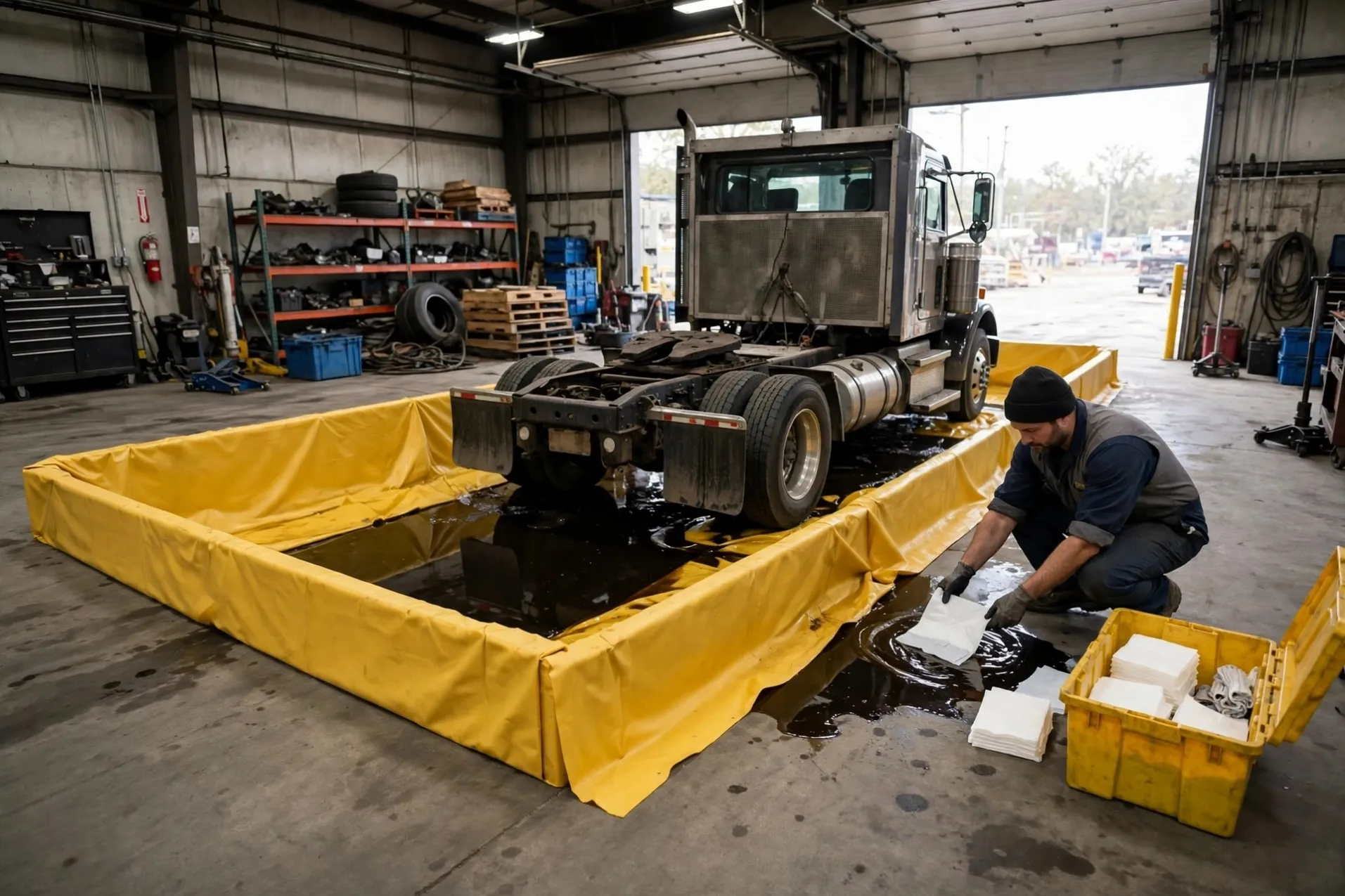
A prime mover rolls into a transport depot for a scheduled service. The mechanic is under the truck when a cracked fuel line lets go — diesel runs across the concrete floor of the wash bay, heading for the stormwater pit at the edge of the shed. The crew has a spill kit, but a kit cleans up after the fact. What the depot really needed was a bund already in place under the truck: a spill containment berm.
A spill containment berm is a portable bund — a heavy-duty fabric floor with raised walls that catches leaks, drips and overfills before they reach the floor, the drains or the soil. Two types dominate the market: foldable berms, with bracket-supported walls, and drive-over berms, with collapsible foam walls. They look similar in a catalogue photo, but they behave very differently on a working site. The wrong choice is a berm that gets driven around, left folded in the corner, or removed because it slows the job down.
How Does a Foldable Berm Work?
A foldable berm is a flat PVC-coated fabric floor with walls held upright by support brackets. You unfold it, raise the walls, lock the brackets in place, and you have a bund sized to whatever sits inside it — drums, an IBC, a generator or a piece of plant.
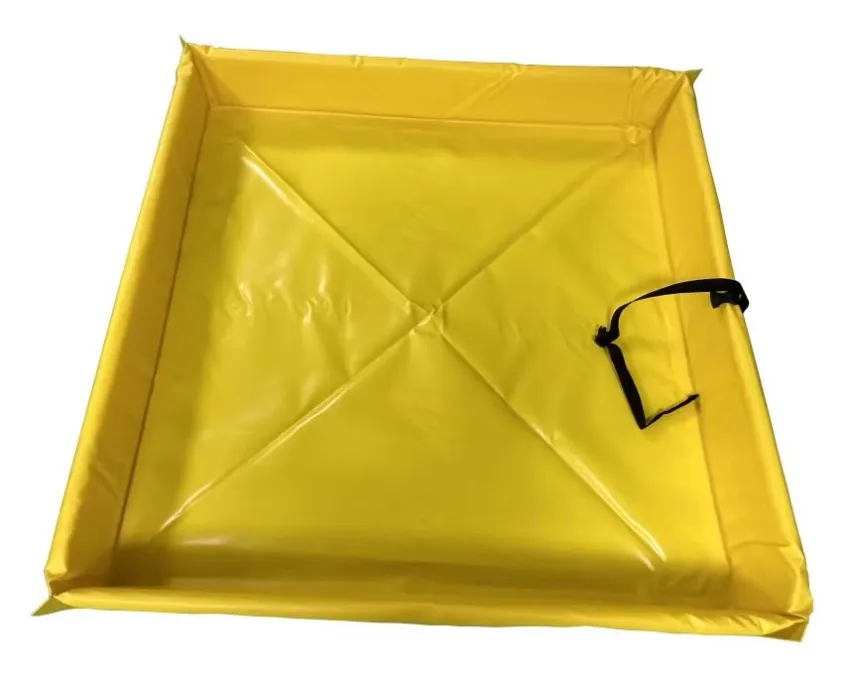
A foldable berm gives you the taller wall: typically 300 mm, twice the height of a drive-over berm's wall. That height matters, because a berm's capacity is its floor area multiplied by its wall height — a 3.6 × 3.6 m foldable berm with 300 mm walls holds roughly 3,800 litres before it overflows, enough for a full IBC plus a margin. The trade-off is access: nothing drives over a bracket wall. Equipment has to be lifted or rolled in before the walls go up, and the walls come down again before anything leaves.
How Does a Drive-Over Berm Work?
A drive-over berm has foam-filled walls instead of brackets. The foam stands the wall up to contain a spill, collapses flat when a wheel drives over it, and springs back up afterwards. Trucks, forklifts and loaders drive straight in and out without anyone touching the berm.
A drive-over berm gives you the lower wall: typically 150 mm, because a foam wall that tall is about as high as a wheel can comfortably climb over. The same 3.6 × 3.6 m footprint with 150 mm walls holds roughly 1,900 litres — half the capacity of the foldable berm at the same size. But the bund is always in place. Nobody has to remember to raise the walls, and nobody removes it because it is in the way. For a bay where vehicles come and go all day, that is the difference between containment that works and containment that sits in the corner.
Foldable vs Drive-Over at a Glance
| Foldable berm | Drive-over berm |
|---|---|---|
Wall | Bracket-supported, typically 300 mm | Collapsible foam, typically 150 mm |
Vehicle access | No — equipment placed inside before walls go up | Yes — drive straight in and out |
Capacity (3.6 × 3.6 m) | ~3,800 L | ~1,900 L |
Setup | Unfold, raise walls, lock brackets — minutes | Lay it out — ready immediately |
Best for | Drums, IBCs, generators, temporary plant | Vehicle bays, wash bays, loading areas |
Wall heights and capacities above are typical figures for these berm types; check the size and wall height on the product page for the model you order, and confirm it against your largest container before you buy.
Which Berm Fits Your Site?
Start with one question: does anything with wheels need to cross the bund while it is in use? If the answer is yes — a truck bay, a wash bay, a maintenance shed where forklifts drive in and out — choose the drive-over berm. Its lower capacity is the price of a bund that stays in place all day, every day.
If the answer is no — a generator on a remote site, an IBC in a yard, drums stored outdoors, a tanker being loaded — choose the foldable berm. Its taller walls hold more liquid, it folds flat for transport between sites, and the brackets take minutes to set up.
Either way, size the berm to your largest container, not your average one. Australian EPA guidance in most states asks for secondary containment sized to at least 110% of the largest container stored inside it, and a berm that is too small is a bund that overflows. A 1,000-litre IBC needs a berm holding at least 1,100 litres — the 3.6 × 3.6 m drive-over berm above does that with room to spare; the foldable berm at the same size holds more than three times that. In hot weather, keep the berm out of direct sun when it is not in use, and hose it down after a spill so diesel and oil do not sit on the fabric.
What to Do When a Spill Happens Inside the Berm
The berm contains the liquid; it does not clean it up. Once the leak is stopped, soak up the pooled liquid with absorbent pads and socks, then bag the used absorbents for disposal. Keep a 120L Oil Spill Kit beside the berm — a kit that size handles a full drum leak — and oil absorbent pads for the drips and the final wipe-down. For fixed drum storage that never moves, a 4 Drum Spill Pallet or an IBC Spill Pallet is the simpler answer; the berm is for the places a pallet cannot go.
If your site handles chemicals rather than fuels, check the chemical compatibility of the berm fabric before you order — PVC-coated fabric suits most oils, fuels and general chemicals, but aggressive solvents and strong acids need a different material. Ask the supplier for the compatibility list, and keep the answer with the berm's inspection record.
Request a Quote
A berm that fits your site is cheaper than a spill that reaches the drain. Contact Anwill for a quotation or email [email protected]. Chengdu Anwill Technology Co., Ltd. (Anwill) is a spill control products manufacturer in China since 2009, with customers in over 40 countries — foldable berms and drive-over berms are available in standard sizes and custom sizes to fit your drums, IBCs, vehicles and bays.