Absorbent Socks vs Booms vs Pillows: When to Use Each
Socks ring a spill, booms fence oil on water, pillows soak up pooled oil where pads can't reach. Which one to grab first — and the mistakes that waste all three.
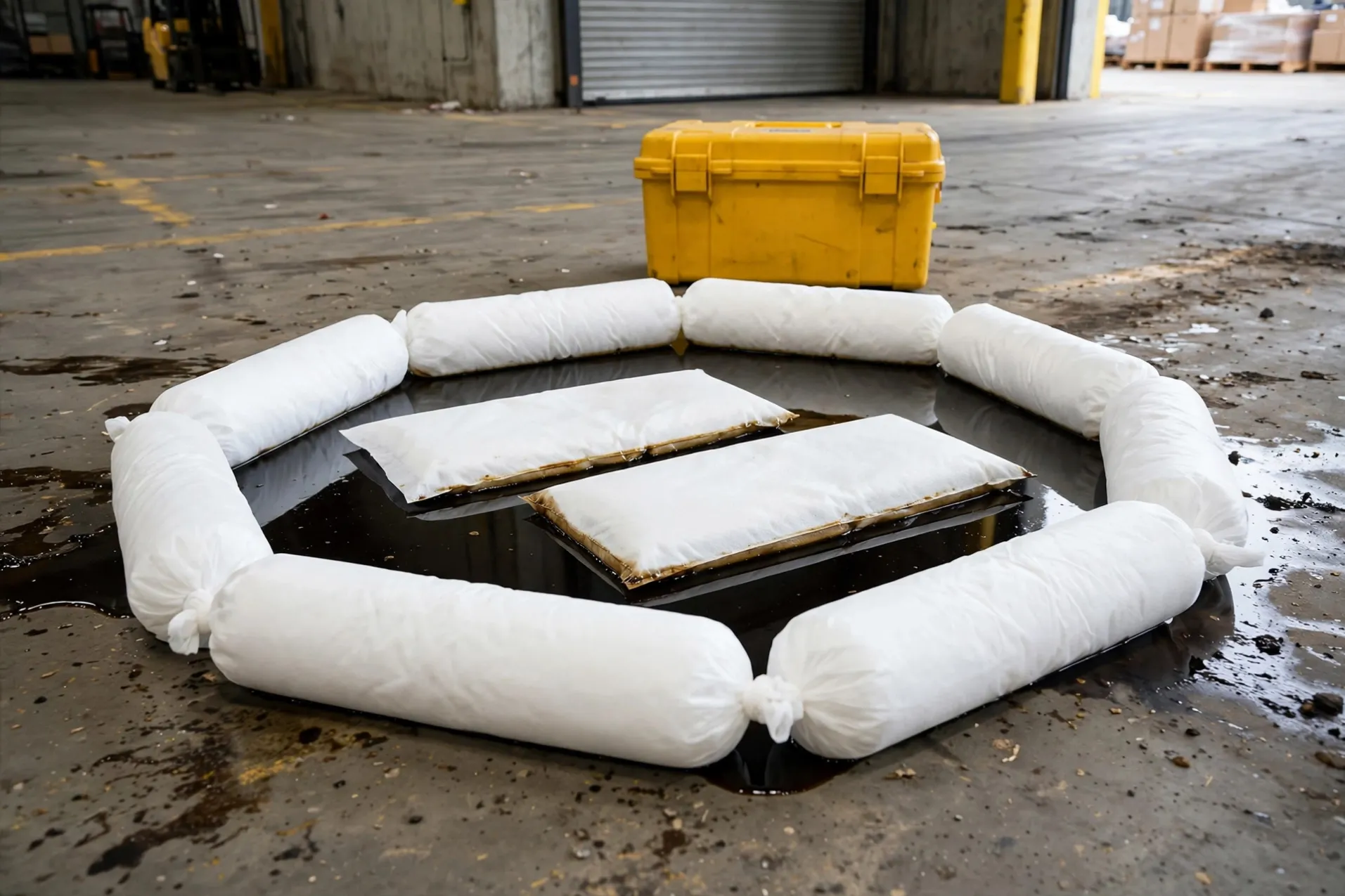
A hydraulic hose lets go on a forklift at a warehouse loading dock, and in ten seconds a black pool of oil is spreading across the concrete toward a floor drain. The nearest worker grabs the spill kit, pulls out a long white tube and lays it across the oil's path. The oil stops at the tube. A second worker slides a thick white pillow under the forklift where the oil is still dripping, and a third lays pads over the middle. Fifteen minutes later the floor is dry, the drain is clean, and the used absorbents are in a disposal bag.
On another dock, the same spill goes differently. The crew throws pads straight onto the spreading pool: the pads soak up the middle, but nothing stops the edges, and the oil reaches the drain. Or someone drags out a boom — the long floating tube meant for water — and lays it on concrete, where it rolls, wasting a tool built for a pond.
An absorbent sock is a flexible tube of meltblown polypropylene that rings a spill to stop it spreading; an absorbent boom is a longer, thicker floating tube that fences oil on water and soaks it up as it holds it back; an absorbent pillow is a thick, flat pad that soaks up a large volume of pooled liquid where a flat pad cannot reach. They look alike — all white, all polypropylene, all oil-only — but they do three different jobs, and grabbing the wrong one is how a small spill becomes a reportable one.
Socks vs Booms vs Pillows at a Glance
| Sock | Boom | Pillow | |
|---|---|---|---|
| Shape | Flexible tube, 3 in diameter | Thicker floating tube, 5 in diameter | Thick flat pad |
| Standard size | 4 ft long (10 ft available) | 10 ft long (16 ft available) | 16 x 20 in |
| Main job | Contain on land — ring a spill | Contain and absorb on water | Soak up pooled liquid in tight spots |
| Floats? | Yes — keeps working on wet floors and in sumps | Yes — stays on the surface and follows waves | No — use on floors, in trays and sumps |
| Typical use | Machine bases, drums, doorways, drains | Ponds, harbours, fuel docks, shorelines | Under machinery, drip trays, sumps, bunds |
| Packing | 10 or 20 per box | 4 per bag | 10 or 20 per box |
All three absorb up to 20 times their own weight in oil and repel water. The difference is not what they absorb — it is where they work and what shape the job needs.
When Do You Reach for a Sock?
A sock is the first thing out of the kit when liquid is moving across a floor. Lay it in a ring around the spill, or in a line across the path the liquid is taking — in front of a doorway, around the base of a leaking drum, across a drain. Overlap the ends by a few inches so the ring has no gap; oil finds the one gap you leave. The tube bends around drum bases and door thresholds, which is exactly what a straight pad cannot do.
Socks block the spread and soak up the leak at the same time. Once the ring holds, lay pads inside it to take up the pooled liquid — our guide to oil absorbent pads: GSM, size and when to use 100 vs 200 vs 400 GSM covers which weight to use. See our Oil Absorbent Socks — 3 in x 4 ft, with a 10 ft length for longer runs, in oil-only, universal and chemical types.
When Is a Boom the Right Call?
A boom belongs on water. On a pond, a harbour, a fuel dock or a shoreline, clip the booms end to end and build a fence as long as the spill needs — each 10 ft section links to the next, so the barrier grows with the job. The boom floats, follows the waves, and absorbs oil while it holds the sheen back. Build the fence first, then recover what is inside it: skim the thicker oil off the surface, then use pads and booms inside the contained area to pick up what is left.
Do not confuse an absorbent boom with a containment boom: the inflatable PVC containment boom — our Eco-Friendly Oil Spill Containment Boom (WQV-500C) — is a barrier in 33 ft sections, 20 in total height with a 6 in freeboard and an 11 in skirt, that holds oil back on harbours and rivers but absorbs nothing. For a pond or a fuel dock, use the absorbent boom; for a harbour or a river, the containment boom fences and absorbent booms and pads recover inside it. See our Oil Absorbent Booms — 5 in x 10 ft, clips included, 4 per bag.
When Does a Pillow Beat a Pad?
A pillow is for pooled liquid where a flat pad cannot work: slide it under a leaking machine, drop it into a drip tray or a sump, tuck it into a bund corner where oil has collected. At 16 x 20 in it holds a large volume in a small footprint and absorbs up to 20 times its own weight in oil — a pad on a deep pool floats and saturates at the edges, while a pillow sits in the pool and draws it in. Lift it out by the outer skin, which holds together under the weight instead of tearing and dropping the oil back on the floor.
Pillows are the quiet workhorse of a spill kit: nobody reaches for them first, and they are the item that runs out first on a real leak. See our Oil Absorbent Pillows — 16 x 20 in, meltblown polypropylene, oil-only.
What Goes Wrong When You Pick the Wrong One?
- Pads alone on a spreading spill: nothing stops the leading edge, and the oil reaches the drain while the pads are still soaking up the middle. Ring it first, then pad the inside.
- A boom on a concrete floor: it rolls, it is too thick to mould around a doorway, and you have burned a water tool on a land job. A sock does the same job for a fraction of the length.
- A sock on open water: it drifts, it is too short to fence a sheen, and it saturates before the job is done. Link booms end to end instead.
- A pillow as a dam: it soaks through and the spill walks around it. Pillows absorb; socks and booms contain.
- The wrong type for the liquid: oil-only white on a chemical spill is a mismatch — the absorbent has to match the liquid. Yellow chemical versions exist for acids and alkalis, grey universal for mixed or unknown liquids. If you cannot name the liquid in five seconds, treat it as chemical and check the safety data sheet before you touch it.
How Much of Each Should You Stock?
The fastest way to have all three on hand is a stocked spill kit: a 120L Oil Spill Kit carries 75 pads, 4 socks, 5 pillows, 6 disposal bags, 2 pairs of gloves and 2 pairs of goggles in a wheeled bin — enough for a drum leak or a burst hose. Keep spare socks beside the drum store and a spare bag of booms near any water on site, and check the kit every month — our spill kit inspection checklist covers the monthly count, item by item.
The rule is simple enough to teach in one toolbox talk: socks stop it moving, booms fence it on water, pillows soak up the pool. Get the shape right and a 15-minute cleanup stays a 15-minute cleanup.
Request a Quote
Tell us what liquids your site stores and where they can spill — loading dock, machine shop, fuel dock or pond — and we can recommend the right socks, booms and pillows, in oil-only, universal or chemical types, supplied in cartons or as part of a custom spill kit. Contact Anwill for a quotation or email [email protected]. Chengdu Anwill Technology Co., Ltd. (Anwill) is a spill control products supplier in China, with customers in over 40 countries.