Oil Absorbent Pads Explained: GSM, Size and When to Use 100 vs 200 vs 400 GSM
Oil absorbent pads come in 100, 200 and 400 GSM — same 40×50 cm size, different thickness and capacity. Learn which weight suits drips, workshop spills and heavy leaks.
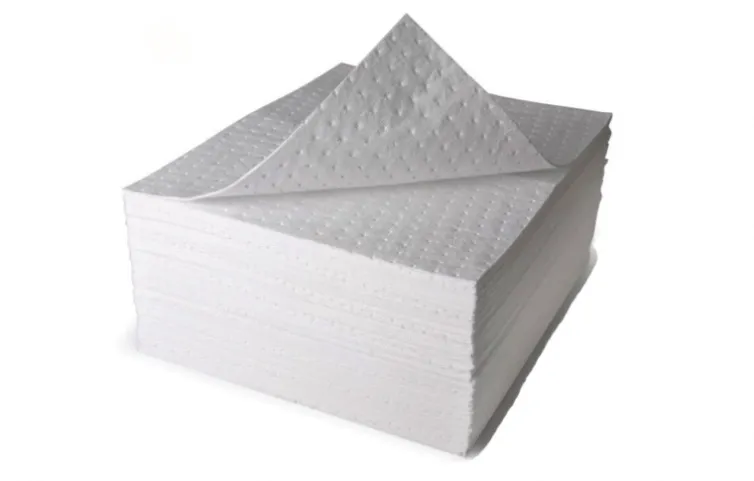
Oil absorbent pads are the workhorse of spill response: cheap, fast to deploy, and the first thing most workers reach for when oil hits the floor. But pads are not all the same. The number on the box — 100, 200 or 400 GSM — decides how much oil each pad can hold, how many you get per carton, and which jobs it is actually suited to. Pick the wrong weight and you either waste pads on a small drip or run out halfway through a real leak.
What Does GSM Mean?
GSM stands for grams per square metre — the weight of the absorbent material in one square metre of pad. A higher GSM means a thicker, heavier pad with more fibres to soak up liquid. It is the simplest way to compare pads from different suppliers, and it tells you more about performance than the pad's size alone.
Anwill oil absorbent pads are made from 100% meltblown polypropylene and come in one standard size — 40 × 50 cm — in three weights: 100, 200 and 400 GSM. The thicker the pad, the fewer pads fit in a carton, but the more each individual pad absorbs. For wiping rather than laying flat, the same meltblown material comes as industrial wipes, in the same colour code and weights.
100 vs 200 vs 400 GSM at a Glance
| Weight | Thickness | Pads per carton | Best for |
|---|---|---|---|
| 100 GSM | ~1 mm | 400 | Light drips, wiping, everyday maintenance |
| 200 GSM | ~2 mm | 200 | General workshop spills, the all-round standard |
| 400 GSM | ~4 mm | 100 | Heavy leaks, pooling oil, high-capacity clean-up |
All three weights are the same 40 × 50 cm sheet, so they fit the same spill kits, the same storage shelves and the same disposal bags. What changes is how much oil a single pad holds and how long it keeps working before it is saturated.
100 GSM — The Everyday Pad
The 100 GSM pad is thin and light, and it is the most economical choice per pad. It is ideal for the small, routine jobs that happen every day: wiping a dipstick, catching drips under a machine, cleaning a workbench after servicing. Because it is thin, it is also easy to fold and tuck into tight spaces.
Its limitation is capacity. A 100 GSM pad saturates quickly on a larger spill, so for anything more than a light drip you will go through several pads in a row. It is a maintenance pad first and an emergency pad second.
200 GSM — The Standard Choice
The 200 GSM pad is the one most sites stock in bulk, and for good reason: it is the best balance of capacity and cost. Thick enough to handle a real spill from a drum or a hose, thin enough to stay flexible and easy to handle, and supplied 200 to a carton, it covers the widest range of everyday spill response.
If you are stocking a spill kit, a workshop or a vehicle and can only choose one weight, choose 200 GSM. It is the standard pad in Anwill's Oil Absorbent Pads 200gsm and in most of our spill kits, from the portable 20L kit up to the 660L wheeled bin.
400 GSM — Maximum Capacity Per Pad
The 400 GSM pad is the heavy-duty option. At around 4 mm thick it holds far more oil per pad than the lighter weights, which matters when the spill is pooling and you need each pad to do more work before it is replaced. Use it under a leaking machine, in a drip tray, or as the first layer on a large spill where capacity matters more than the number of pads used.
The trade-off is cost per pad and bulk: a carton holds 100 pads instead of 200 or 400. For sites that deal with heavy oil leaks regularly — fuel handling, hydraulic maintenance, engine workshops — the extra capacity is worth it.
How Much Oil Can a Pad Hold?
As a general industry guide, a meltblown polypropylene pad can absorb many times its own weight in oil — commonly quoted at up to around 20 times for standard pads. The exact figure depends on the oil type, temperature and how long the pad is left in contact with the liquid, so treat it as a rule of thumb for planning, not as a certified specification for any single product. What matters in practice is simple: a heavier pad absorbs more per sheet, so you use fewer of them on a big spill.
Oil-Only, Universal or Chemical — Check the Colour
GSM is only half the story. Pads also come in different types, and the colour tells you which is which:
- White — oil-only. Absorbs oil, diesel and fuel while repelling water, so it keeps working on wet floors and even on water. Use it for hydrocarbons only.
- Grey — universal. Absorbs oil, water, coolants and most common workshop liquids. The choice when the spill could be almost anything — see our Universal Absorbent Pads 200gsm.
- Yellow — chemical. Made for acids, alkalis and aggressive chemicals, and bright yellow so the right pad is easy to spot in an emergency — see our Chemical Absorbent Pads 200gsm.
If you are still deciding which absorbent type to choose, see our comparison of universal, oil-only and chemical absorbents.
Never use a white oil-only pad on a chemical spill, and never use a universal pad where oil has reached water — the wrong pad wastes capacity and can make the clean-up slower.
How to Use Pads Properly
A few habits make pads work much better:
- Lay pads on the spill, don't push them through it. Place the pad on top of the liquid and let it soak up from below; pushing spreads the oil further.
- Work from the outside in. Ring the spill with pads or oil absorbent socks first to stop it spreading, then lay pads over the middle.
- Replace saturated pads. A pad that is soaked through stops absorbing. Lift it out, bag it, and lay a fresh one down.
- Dispose of used pads correctly. Used pads are contaminated waste — bag them in the disposal bags supplied with your spill kit and follow local waste rules.
Pads Belong in Every Spill Kit
Pads are the core absorbent in every Anwill spill kit, because they are the fastest way to deal with liquid already on the floor. A 120L kit, for example, carries 75 pads alongside socks, pillows and disposal bags — enough to handle a substantial drum leak. If your site stocks pads separately, keep them beside the kit, not in a distant storeroom: a pad you cannot reach in thirty seconds is a pad you will not use. For larger areas, pair pads with oil absorbent rolls to cover walkways and workbenches fast, and with socks to contain the leak at its source.
Request a Quote
Not sure which weight or type your site needs? Tell us what you store and how much, and we can recommend the right pads — in 100, 200 or 400 GSM, oil-only, universal or chemical — and supply them in cartons or as part of a custom spill kit. Contact us for a quotation — or email [email protected]. Anwill has manufactured spill control products in China since 2009, serving customers in over 40 countries.