Industrial Wipes: Choosing the Right Wipe for Oil, Solvents and General Cleaning
Oil, solvent or just shop grime? The wrong wipe tears, sheds lint or spreads the mess. Here's how to match the wipe to the liquid — and what to keep at each workstation.
The press had been running since the early shift, and the hydraulic line above the parts washer had started weeping — a slow drip of oil onto the bench, one drop every few seconds, right where a technician was degreasing brackets with solvent before they went to coating. He reached for the nearest wipe, the thin general-purpose kind kept in a box by the door, and went to work. The wipe tore on the first pass. The second one soaked through and left a smear of lint across a bracket that was supposed to go to coating clean. By the time he found the heavy-duty wipes in the store, the oil had run off the bench and onto the floor, the solvent had evaporated and left a film, and two brackets had to be re-cleaned from scratch. The job took forty minutes instead of ten — not because the spill was big, but because the wipe was wrong.
An industrial wipe is a single-use absorbent sheet made to pick up a liquid and hold it, so the liquid comes off the surface instead of being pushed around. That sounds simple, and it is — until the wipe meets the wrong liquid. Oil, solvent and water-based grime each need a different wipe, and the differences are not cosmetic: the wrong material tears, sheds fibres, or simply will not absorb what is in front of it.
Which Wipe Do You Need for Oil?
Oil is the easiest case, and the one most often got wrong. An oil-only wipe is white meltblown polypropylene, made to absorb oil, fuel and hydraulic fluid while repelling water — so it keeps working on a wet bench or a damp floor, and it will not waste its capacity soaking up water. A white wipe laid on an oil spill takes the oil and leaves the water behind; a grey universal wipe on the same spill takes both, and saturates twice as fast.
For a hydraulic leak, a weeping fitting or an oily film on a machine, the right tool is a white oil-only wipe, in a weight that matches the volume: a light wipe for a film and a fingerprint, a heavy one for a puddle that needs soaking up in one pass. Our Oil Absorbent Wipes are white meltblown polypropylene in the same 40 × 50 cm sheet as our absorbent pads — the same material, cut for wiping instead of laying flat. If the oil has spread beyond the bench, pair the wipes with Oil Absorbent Pads 200gsm for the floor and keep the wipes for the machine itself.
What About Solvents and Degreasers?
Solvents are where wipes fail most visibly. A wipe that handles oil happily can go soft, tear or fall apart in a strong solvent, because the solvent attacks the fibres themselves. The rule is simple: check the safety data sheet (SDS) for the solvent before you choose the wipe, and if the SDS lists the liquid as aggressive, use a chemical-rated wipe — yellow, the same colour code as our chemical absorbent pads — not the general grey wipe from the box by the door.
In practice, most day-to-day degreasing — parts washers, brake cleaner, general solvent wiping — is handled by a heavy-duty universal wipe: thicker meltblown material that stays in one piece when wet and can be wrung out and used again on the same job. Our Heavy Duty Wipes are the thickest wipe in the range, built for degreasing engines, scrubbing grime off machinery and cleaning up major leaks without tearing. But "heavy duty" is not "chemical proof": for acids, alkalis and aggressive chemicals, the wipe must be rated for the chemical, and the SDS is the document that decides — never guess from the colour of the liquid.
The Six Wipe Types at a Glance
| Wipe type | Colour | Picks up | Best for | Avoid for |
|---|---|---|---|---|
| Oil absorbent | White | Oil, fuel, hydraulic fluid; repels water | Oily benches, wet floors, fuel handling | Water-based coolant, chemical spills |
| Industrial cleaning (universal) | Grey | Oil, water, coolant, general grime | Everyday wiping, mixed workshop dirt | Oil on open water, aggressive chemicals |
| Heavy duty | White or grey | Large volumes of oil, grease, coolant | Degreasing, major leaks, scrubbing | Precision surfaces where lint matters |
| Lint free | White | Oil and light liquids, without shedding fibres | Electronics, optics, coated parts, labs | Heavy oil — it is a finishing wipe, not a mop |
| Disposable | White or grey | Light wiping, first pass on a spill | Hands, tools, workstations, spill kits | Jobs needing scrubbing strength |
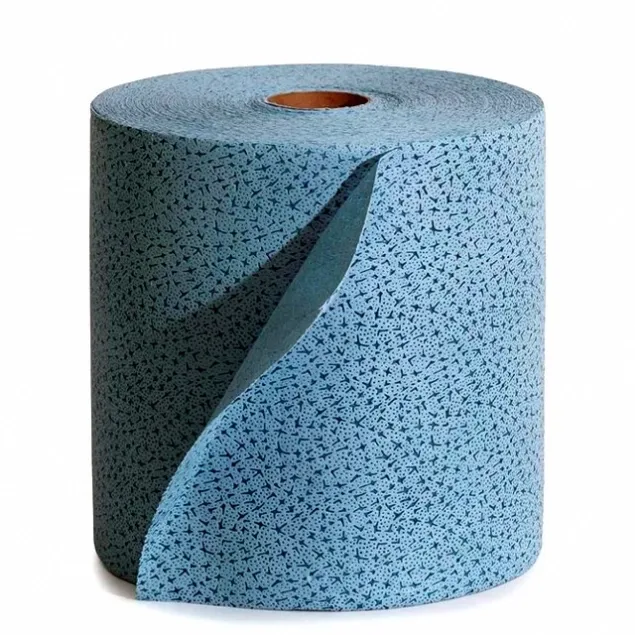
| Nonwoven (rolls) | White / grey / yellow | Same range, cut to length | High-volume wiping, custom sizes | Nothing specific — match the colour to the liquid |
The colour code is the same one our absorbent pads use — white for oil-only, grey for universal, yellow for chemical — so a crew that already knows the pad system does not have to learn a second one. Our guide to universal vs oil-only vs chemical absorbents explains the colour system in full, and it applies to wipes exactly as it does to pads.
Lint: The Problem You Only See After Coating
Lint is the quiet failure. A wipe that sheds fibres leaves them on every surface it touches — invisible on a greasy bench, obvious on a part that has just been degreased for coating, painting or assembly. One lint-covered bracket sent to coating comes back as a reject, and the rework costs far more than the wipe saved.
The fix is a scrim-reinforced wipe: a meltblown sheet with a scrim layer that increases strength and helps eliminate linting — the same construction our catalogue notes for our absorbent pads. For any surface that must stay clean — lenses, screens, circuit boards, freshly machined or coated parts — use a lint-free wipe and nothing else. Our Lint Free Wipes are scrim-reinforced for exactly that work. For general workshop wiping where lint does not matter, the economical choice is our Industrial Cleaning Wipes: grey, universal, and strong enough for machinery, benches and tools.
Why Not Just Use Rags?
Rags are the default in many workshops, and they have two costs that do not show up on a purchase order. The first is cross-contamination: a rag used on oil yesterday, laundered or not, carries residue into today's solvent wipe-down, and a rag that has touched a chemical has no business near a food-contact surface. The second is consistency: one rag is thick cotton, the next is a torn T-shirt, and nobody can say how much either one absorbs. A disposable wipe is the same every time, it goes in the disposal bag after use, and the next job starts with a clean one.
That does not mean every wipe is single-use in the strict sense — a heavy-duty wipe can be wrung out and reused on the same job — but the habit to build is this: one wipe, one job, then dispose of it with the waste it picked up. A wipe that has absorbed oil or solvent is contaminated waste, and it goes in the disposal bag, not back on the shelf.
How Many Wipes Should Each Workstation Hold?
The test is thirty seconds. If a technician has to leave the bench, walk to the store and come back, the spill has already spread — and in a plant where benches sit close together, a small leak becomes a floor spill in the time it takes to fetch a box. Keep a pack of the right wipes at each workstation: universal grey for general benches, white oil-only where hydraulics and fuel are handled, lint-free where parts go to coating. Keep the heavy-duty wipes beside the parts washer and the maintenance bay, where the big jobs happen.
Stock by the job, not by the carton. A bench that sees a hydraulic drip once a week needs a light pack; a parts washer that runs all shift needs rolls. Wipes are commonly sold as 40 × 50 cm sheets or on rolls you cut to size — buy the format that matches how the crew actually works, and check the stock when you check the spill kits, not when the box is already empty. For a deeper look at how weight and size fit the choice, see our guide to oil absorbent pads: GSM, size and when to use 100 vs 200 vs 400 GSM.
Request a Quote
The technician in that bay had the right reflex — he reached for a wipe first. What he needed was the right wipe within arm's reach. Tell us what liquids your site handles and how your crews work, and we can recommend the wipe type, weight and format for each workstation — oil-only, universal, heavy duty or lint free — supplied in packs, cartons or rolls, or as part of a custom spill kit. Contact Anwill for a quotation or email [email protected]. Chengdu Anwill Technology Co., Ltd. (Anwill) is a spill control products supplier in China, with customers in over 40 countries.