Flammable Safety Cabinets: The 8 Questions Buyers Ask Most
Eight questions every buyer asks before ordering a flammable safety cabinet — size, doors, shelves, placement and what to store — answered against a real range from 4 to 110 gallons.
A safety walk-through at a fabrication workshop: the auditor opens the store-room door and finds paint tins, thinners and aerosols stacked on open shelving, a dented can weeping solvent onto the shelf below, and a drum of waste thinner standing beside a space heater. Nothing has caught fire. Nothing has spilled on the floor yet. But every flammable the site owns is sitting out in the open, in the path of anyone with a grinder, and the only thing between a leak and the drain outside is the concrete.
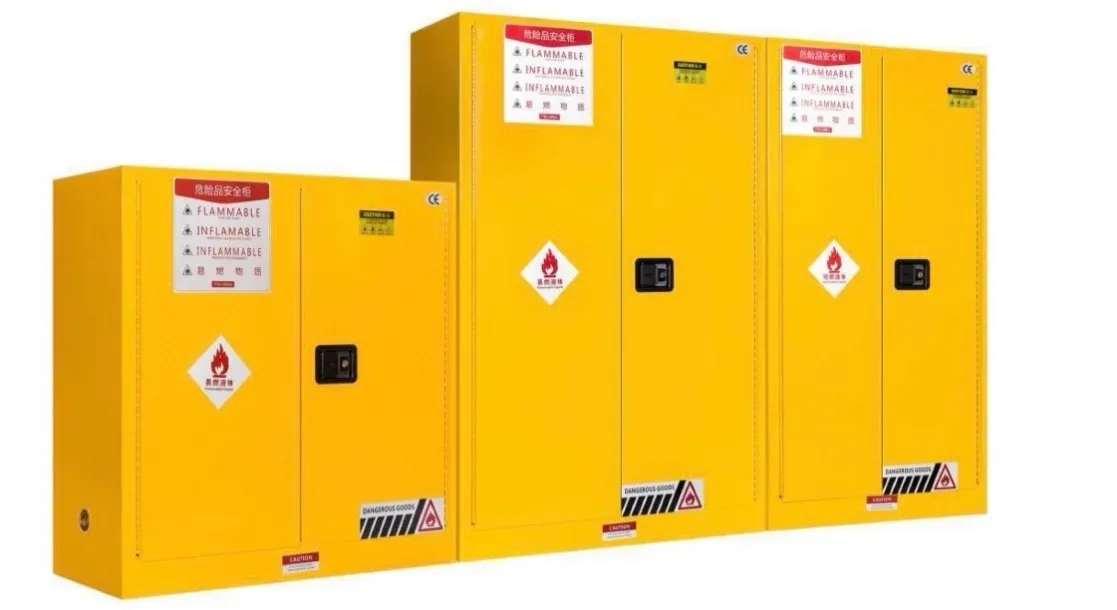
A flammable safety cabinet is a lockable steel cabinet built to hold flammable liquids — paints, solvents, adhesives and fuels — in one controlled place, so a leak or a fire stays inside the cabinet instead of spreading across the store. The questions below are the ones buyers actually ask before ordering one, answered against the range Anwill supplies: eight cabinets from 4 to 110 gallons, all yellow steel, all with manual-close doors, latch handles and flammable warning labels.
1. What size do I need?
Count what you actually store, then buy for the largest day, not the average one. List every container of flammable liquid on site, add up the litres, and add roughly a third of headroom for the delivery that arrives the week you are fullest. A cabinet that is full on the day it arrives is already too small.
| Cabinet | Capacity | Dimensions (H × W × D) | Doors | Adjustable shelves |
|---|---|---|---|---|
| 4 gallon | 15 L | 560 × 430 × 430 mm | Single | 1 |
| 12 gallon | 45 L | 890 × 590 × 460 mm | Single | 1 |
| 22 gallon | 83 L | 1650 × 590 × 460 mm | Single | 3 |
| 30 gallon | 114 L | 1118 × 1100 × 460 mm | Double | 1 |
| 45 gallon | 170 L | 1650 × 1100 × 460 mm | Double | 2 |
| 60 gallon | 227 L | 1650 × 865 × 865 mm | Double | 2 |
| 90 gallon | 340 L | 1650 × 1100 × 865 mm | Double | 2 |
| 110 gallon | 416 L | 1650 × 1500 × 865 mm | Double | 2 |
Mostly small cans? The 12 or 22 gallon does the job. Bulk containers and reserve stock? Start at the 45 or 60 gallon and work up.
2. Single door or double doors — does it matter?
It matters the moment you reach for something at the back. The 4, 12 and 22 gallon cabinets have a single manual-close door, which suits a bench-top or narrow wall run where you take one or two cans at a time. From the 30 gallon up, the cabinets have two manual-close doors, and that width of opening is what makes a full-size cabinet usable: you can see the whole shelf and lift a wide container straight out without dragging it past the cans in front. Every door in the range is manual-close with a latch handle, so the cabinet stays shut because someone shut it — which is also the discipline to train.
3. How many shelves, and do they adjust?
Between one and three, and yes, they adjust. The 4 and 12 gallon cabinets have one adjustable shelf, the 30, 45, 60, 90 and 110 gallon have two, and the tall slim 22 gallon has three — the most shelving in the range, because its 1650 mm height is split into three levels instead of two. Set the shelf heights for the containers you actually hold.
Shelves are also how you separate stock inside the cabinet: solvents on one level, paints on another, aerosols apart from the rest. If a can leaks, the shelf below it is where the liquid lands first — so keep a spill kit and absorbent pads at the cabinet, not in another building.
4. What can I store in a flammable safety cabinet?
Paints, solvents, thinners, adhesives and fuels — the flammables a workshop, paint shop or production area uses every week. That is what the range is built for, and it is the stock the cabinets in the table above are sized around.
What does not belong in the same cabinet is the other half of the answer. Keep oxidisers, corrosives and reactive chemicals in separate storage — mixing chemical families in one cabinet is how a small leak becomes a reaction nobody planned for. If a product's safety data sheet says it is incompatible with what is already in the cabinet, it goes in a different cabinet.
5. Where should the cabinet stand?
Close to the work it serves, on a level floor, away from exits, escape routes and ignition sources — and never blocking a fire exit or a spill kit. The 4 gallon cabinet sits on a workbench or under a counter; the 12 gallon fits along a wall or at the end of a workbench run; the tall and full-size cabinets belong in the store room or along the production line where the filling and decanting actually happen.
Two placement mistakes turn up on almost every walk-through. The first is putting the cabinet in the far corner of the building, so the crew decants solvents at the bench and carries open cans across the workshop instead — the cabinet only protects stock that is actually in it. The second is stacking boxes or a spare pallet in front of it, so the doors cannot open fully. Leave the floor in front of it clear, and keep the decanting point — with its spill kit and absorbent pads — right beside it.
6. Does the cabinet need venting or earthing?
Ask your local rules and your insurer before you assume either way. In the EU, flammable-liquid storage sits under national dangerous-substances rules and ATEX thinking, and in the UK under DSEAR — and what those rules require of a cabinet depends on the liquids, the quantities and the room, not on the cabinet alone. Venting, earthing and the distance from ignition sources are site decisions, and the right answer is the one your risk assessment and your insurer accept. Do not store a cabinet beside a heater, a welding bay or any open flame, and do not treat the cabinet as a substitute for ventilation in the room itself.
7. What fire rating should I ask about?
Ask the supplier for the fire-test documentation your insurer or your local rules require, and read it before you order. Fire resistance is the question buyers ask most and the one most often answered with a number nobody can produce a test certificate for — so do not accept a rating on a brochure line alone, and do not assume one cabinet's rating applies to another size in the same range.
What Anwill publishes for this range is the specification you can check: capacity, dimensions, door type, number of adjustable shelves and colour for each of the eight sizes, from 4 to 110 gallons. If your site needs a specific fire-resistance rating, say so in the enquiry — contact Anwill with the rating your insurer asks for.
8. What should sit next to the cabinet?
A spill kit and absorbent pads, at the decanting point, not in another room. Containers are opened, poured and closed at the cabinet, and that is where the drips and the knocked-over can happen. A 20L kit covers a bench-top cabinet; a 50L or 120L kit suits a full-size store where several people decant through the day. Gloves and goggles go with it — the same PPE for spill cleanup the crew already uses at the filling point — and a labelled bin for the used pads.
The pairing is the point of the whole setup. A cabinet keeps a leak inside; the kit next to it cleans up the leak that happens outside the cabinet, at the moment it happens, before it reaches the drain. One without the other leaves half the risk on the floor.
Request a Quote
Eight sizes, one decision: count the stock, measure the largest container, and pick the cabinet the stock actually fits. Browse the full flammable safety cabinet range — from the 4 gallon bench-top cabinet to the 110 gallon (416L) cabinet — or contact Anwill for a quotation, or email [email protected]. Chengdu Anwill Technology Co., Ltd. (Anwill) is a spill control products supplier in China, with customers in over 40 countries — flammable safety cabinets from 4 to 110 gallons, spill kits from 20L to 660L, and the absorbent pads, socks and PPE to go with them.
Flammable liquids on open shelving are one of the most common citation items — if a citation lands, here is the order to do things in.