Blog
How to Read PPE Manufacture and Expiry Dates (and When to Retire Gear)
That hard hat has a date stamped inside it — and your gloves have one on the box. How to read PPE manufacture and expiry dates, and when to retire gear before it fails on the job.
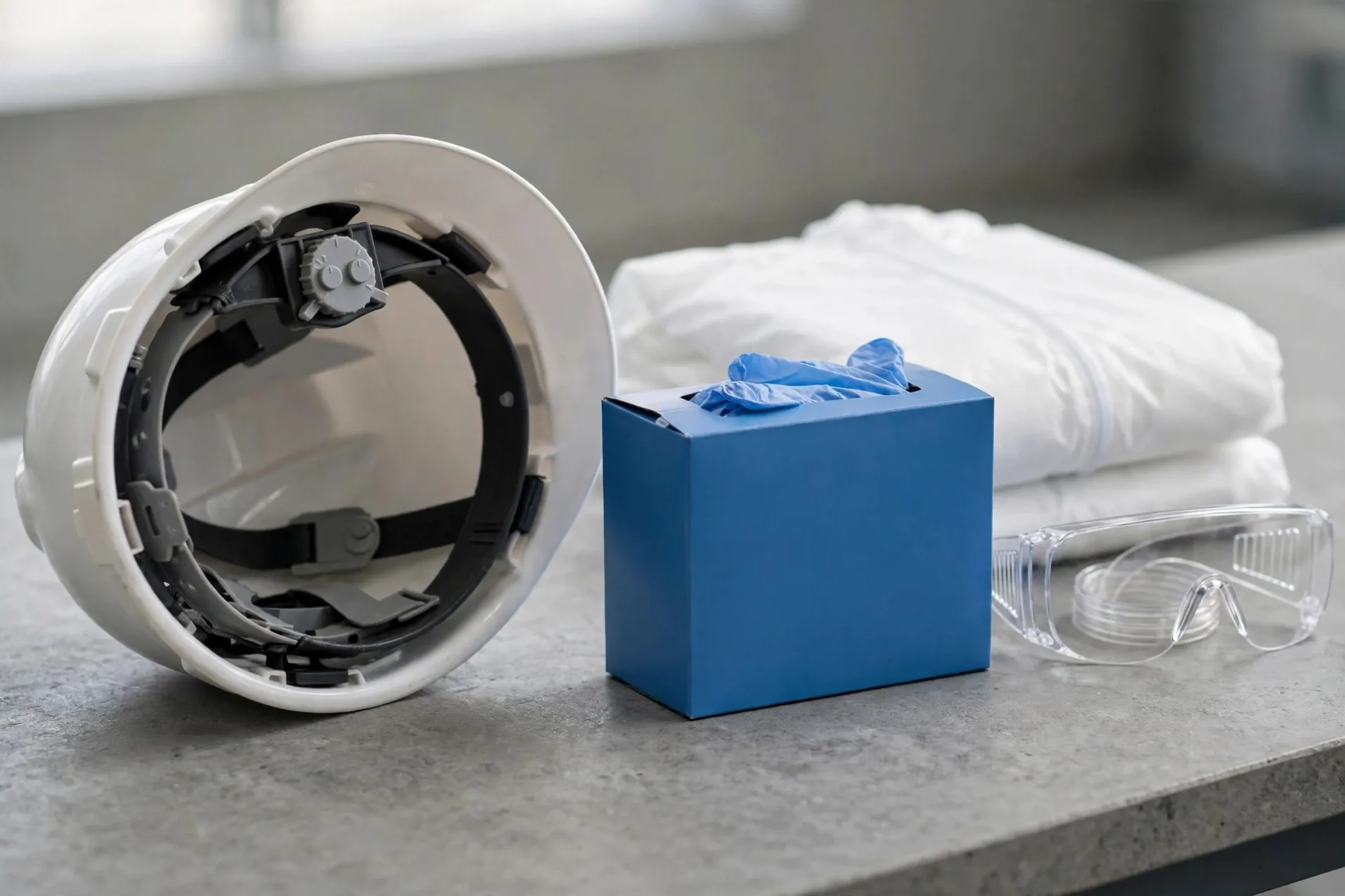
A maintenance fitter is called to a hydraulic leak on a production line. He reaches for the spill kit, pulls out the gloves, and stops: they feel stiff and tacky, and one tears as he pulls it on. The goggles in the kit are scratched cloudy. The hard hat he grabs from the hook has a date dial moulded inside the shell — and the year it points to is four years back. Nothing is broken in the obvious way — it is simply old, and old PPE fails quietly: a glove tearing mid-cleanup, a lens you cannot see through, a shell gone brittle.
PPE manufacture and expiry dates are the dates printed on protective gear that tell you when it was made and until when it can be relied on — the manufacture date is usually moulded or printed on the item, the expiry or "use by" date on the packaging. Gloves, helmets, filters and suits are made of materials that age even on a shelf: rubber stiffens, plastic goes brittle, filter media loses its charge. A date check takes ten seconds and belongs in the same routine as checking the absorbents in the kit.
Where Is the Date on Each Piece of Gear?
Every type of PPE hides its date in a different place. Learn your stock by picking up one of each item and finding its date before the next spill, not during it.
Hard hats carry the date inside the shell, moulded as a small clock-face dial: an arrow points to the month, and the year is moulded around it or stamped nearby. Goggles and face shields carry a date moulded on the frame or printed on the packaging. Disposable gloves print the manufacture and shelf-life dates on the box — never on the glove, so once the box is thrown away, the date goes with it. Respirator filters print a clear "use by" date on the filter body and the sealed pack. Coveralls print the manufacture date on the bag or the label sewn inside the collar. When a box is opened, write the date on the item or on a tag kept with it — the packaging is the first thing thrown away.
How Long Does PPE Actually Last?
There is no single shelf life for PPE — it depends on the material and the storage — but the figures below are the ones most PPE makers publish, and they are a sound planning baseline. Always follow the maker's instructions for the exact item: the printed date on the product overrules any general figure.
Item | Where the date is | Typical service life (general guidance) | Retire it when |
|---|---|---|---|
Hard hat (EN 397) | Clock dial moulded inside the shell | About 5 years from first use | Any impact or crack; past the maker's stated life |
Disposable nitrile gloves | Date on the box | About 3–5 years unopened, stored cool and dry | Stiff, sticky, discoloured, tears on donning |
Sealed goggles (EN 166) | Frame or packaging | No fixed expiry — inspect, don't guess | Scratched lens, cracked frame, strap perished |
Respirator filter (EN 149 / EN 143) | "Use by" on filter and sealed pack | Until the printed use-by date | Past the date, seal broken, breathing resistance rises |
Disposable coverall (EN 13034) | Date on bag or collar label | About 3–5 years in original packaging | Torn seams, stiff or brittle fabric, past the date |
Two things shorten every figure in that table: heat and sunlight. A kit against a sunlit window, on top of a boiler, or in a vehicle cab in summer ages its gloves and helmet far faster than one stored in a cool, dark store — and the date on the box assumes reasonable storage.
What Does the Marking Tell You Besides the Date?
Under the EU PPE Regulation 2016/425, compliant PPE carries the CE mark, the maker's name or trademark, and the standard it meets — EN 374 for chemical-resistant gloves, EN 166 for eye protection, EN 397 for industrial helmets, EN 149 for filtering facepieces. In the UK the same role is played by the UKCA mark. If a piece of gear carries no standard marking at all, its date is the least of the problems: there is no test behind it to trust. The SDS for the chemical being handled, Section 8, names the glove material and eye protection its maker recommends — the check that decides whether the glove in the kit is the right glove, not just one still in date.
When Do You Retire Gear — Date or Condition?
The date is a deadline, not a guarantee: in-date gear that is damaged is already retired, and out-of-date gear is retired even if it looks fine — retire on whichever comes first. A hard hat that has taken a knock is retired on the spot, even if the dial says it has years left; a shell does not have to show a crack to have lost its strength. A glove that tears while being put on was already past use, whatever the box said. A filter past its use-by date is retired even if the seal is unbroken — the media inside degrades with time whether it has been used or not.
Retirement needs a destination, or retired gear creeps back into service. Keep a marked bag or "retired PPE" box beside the kit store and put damaged or expired items straight into it — never back on the shelf "just in case". Replace at the same time as the absorbents are restocked, not next month: a kit with its gloves removed and not replaced sends its next responder in bare-handed. The monthly kit check is the natural moment, and the PPE dates take one extra minute on the same walk. For the inspection routine that covers it, see the spill kit inspection checklist.
Walk the kit store once with this list and the problem is handled for the quarter: glove-box date and feel, the dial inside one hard hat, the goggles held up to the light, one filter pack's use-by date. Anything past its date or showing damage goes into the retired-gear bag and onto the restock list the same day. That is the whole job — and it is the difference between gear that protects someone and gear that only looks like it does. For choosing the right gloves, goggles and coveralls for the liquid in the first place, see PPE for spill cleanup: gloves, goggles and protective clothing.
Request a Quote
PPE only protects people when it is the right type, in date, and actually in the kit. Contact Anwill for a quotation or email [email protected]. Chengdu Anwill Technology Co., Ltd. (Anwill) is a spill control products supplier in China, with customers in over 40 countries — chemical spill kits from 20L to 120L with gloves, goggles and disposal bags included, and portable eyewash stations for the areas where chemicals are handled.