Protective Workwear for Industrial Parks: Fabric, Standards and Job-by-Job Selection
One coverall for every job fails in hot, humid industrial parks. Match fabric, gloves and eye protection to the task — decanting, maintenance, cleaning and spill response.
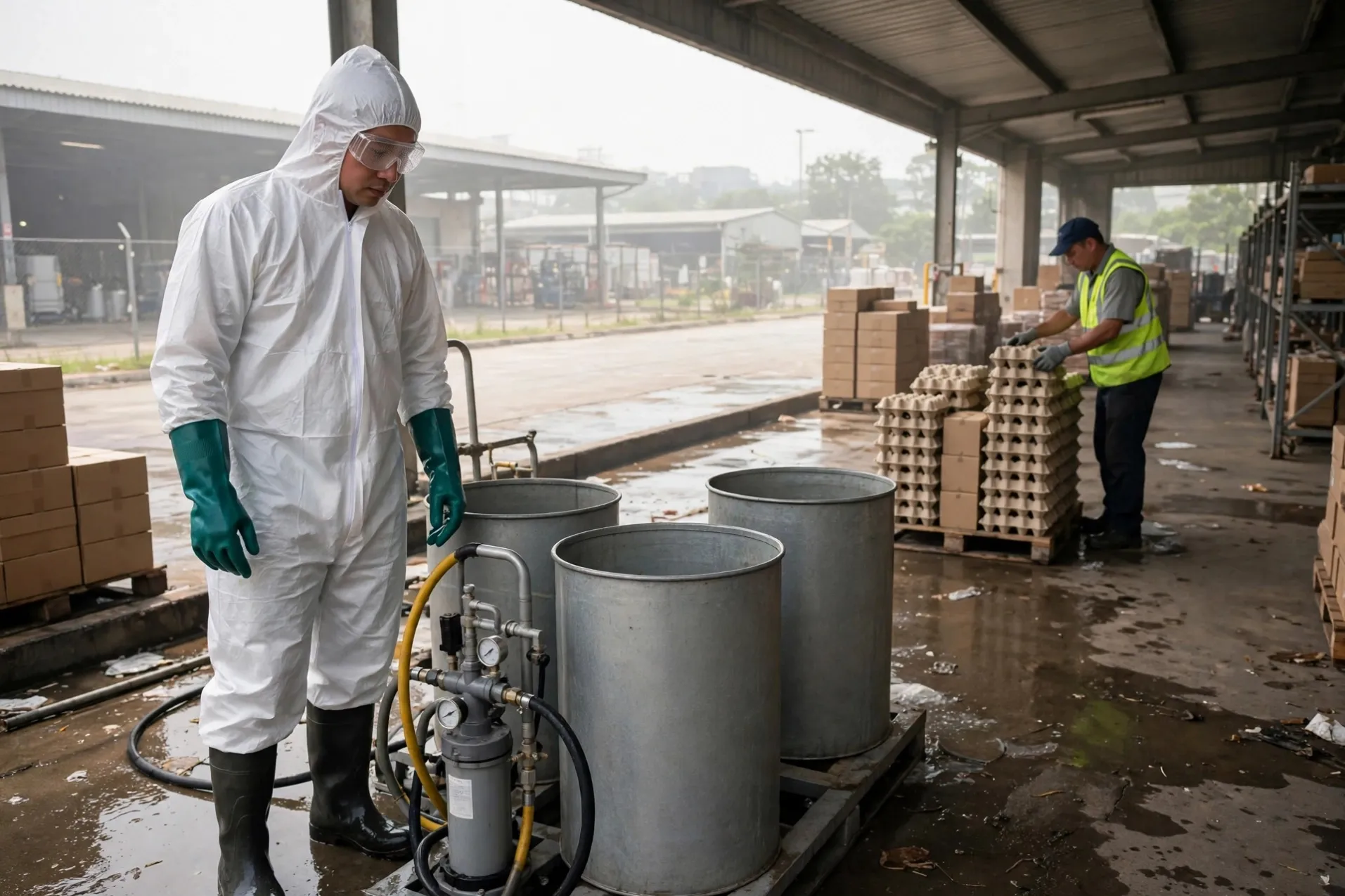
The drum transfer had barely started when the operator pushed his coverall sleeves up to the elbow. The suit was the same heavy disposable issue the whole park wore, the morning was hot and humid, and the cuffs stuck to his wrists. When a coupling wept as the pump stopped, cleaning chemical ran down the drum side onto bare forearm skin. The spill was stopped and washed down; the irritation kept him off chemical work for days. The coverall had not failed — heat had taken it out of the job.
Protective workwear is clothing worn to keep a specific hazard — liquid splash, dust, or contaminated surfaces — off the wearer's skin and everyday clothes during a defined task. In an industrial park, where warehousing, maintenance, cleaning and chemical handling sit side by side, one garment for every job is the mistake: the fabric that protects during a drum transfer is the fabric nobody keeps zipped during a humid loading shift.
Why Does One Coverall for Every Job Fail?
A single-issue coverall fails two ways. Sealed and liquid-resistant, it traps heat; sweat builds, sleeves roll up, zips open, and the barrier is worn open. Light and breathable for comfort, it wets through on first splash and holds liquid against the skin for the rest of the task.
Heat is not a comfort footnote in this climate. Impermeable clothing raises body temperature faster than breathable clothing, so rest breaks, shade and water must be planned with the garment. Ignore heat, and the wearer defeats the selection within the first hour.
Which Fabric Fits Which Hazard?
Start with what touches the garment. Dry dust needs a barrier at neck, wrists and seams. Splash needs fabric and seams that resist wetting through. Spray, pooled liquid, or kneeling in residue needs a higher barrier and chemical-resistant boots.
As general industry guidance, disposable coveralls are often described by the European type system: Type 5 for dry particles, Type 6 for limited liquid splash, Types 3 and 4 for stronger liquid exposure. The type alone does not qualify a garment for a chemical — the safety data sheet, Section 8, and the maker's chemical-resistance data decide. Local occupational safety rules set the legal floor; the SDS and the task set the real specification.
| Park job | Main hazard | Workwear direction | Do not rely on |
|---|---|---|---|
| Dry warehousing, packing | Dust, abrasion, sweat | Breathable workwear or light particle coverall; hi-vis where vehicles move | Sealed chemical suit worn open for air |
| Drum decanting, pump transfer | Splash to forearms, front, boots | Liquid-splash coverall, gloves over sleeves, sealed goggles, chemical-resistant boots | Short sleeves, safety glasses alone, fabric shoes |
| Maintenance on oily lines | Oil soak-through, kneeling in residue | Oil-resistant coverall or apron layer, nitrile gloves, cleanable knee protection | Dust coverall that wets through and stays on |
| Spill cleanup crew | Unknown or pooled liquid | Coverall and gloves matched to the SDS, sealed goggles; stop if liquid is unidentified | Everyday workwear plus pads |
Confirm every chemical task against its SDS and the PPE maker's data before the garment is issued. This table is a starting point, not a certification.
What Standards and Markings Should a Buyer Check?
Check the standard claimed, the protection type, and the date. A type without a test standard behind it is a description, not evidence. Chemical gloves are commonly rated under EN 374 for permeation resistance and eye protection under EN 166; splash work needs sealed goggles, not open safety glasses, because splash enters from below and the sides. For the full glove, goggle and coverall set, see PPE for spill cleanup: gloves, goggles and protective clothing.
Dates matter in hot storage: disposable coveralls, gloves and filters age on the shelf, faster in heat and sunlight. See how to read PPE manufacture and expiry dates. Fit counts too — issue by size, keep spares at the task point, and retire torn seams or split cuffs.
How Should a Park Issue Workwear Job by Job?
Start from the task list, not the storeroom shelf. Write one hazard line per recurring job — dust, splash, soak-through, unknown liquid — then assign garment, gloves, eye protection and footwear as one set per job, stored where that job starts. PPE kept two buildings away is skipped for a two-minute transfer. Keep the decanting set at the bay, the spill set with the spill kit, and a sealed spare for the second responder. In monsoon-season downpours, store sets dry and off the floor; a coverall from a damp pile starts compromised.
Eyes need the same thinking. Where liquids are decanted or lines opened, an eyewash point belongs within a short, unobstructed walk. The Portable Eyewash Station (WJH0982A) holds 8 gallons (about 30 litres), measures 555 × 370 × 255 mm, and starts hands-free when the front tray is pulled down. It needs no plumbed supply, which suits bays and stores beyond fixed plumbing.
What Happens After the Garment Has Done Its Job?
A disposable coverall that took a chemical splash is waste, not laundry. Remove gloves without touching the outside with bare skin, roll the coverall down inside-out, bag it with used absorbents, and wash hands at once. Soaked reusable workwear is bagged and washed separately under the site procedure — never worn home or left to dry for the next shift. Replace every used set the same day, sizes included. The operator in the opening scene needed a splash-rated set he could keep closed in the heat, sized to him, waiting at the bay — and a supervisor who treated rolled sleeves as a stop signal.
Request a Quote
Matching spill-response PPE to the jobs in your park — decanting bays, maintenance lines, chemical stores? Tell us the liquids handled and crew size per task, and we will help you size spill kits, gloves, goggles and eyewash points to the work. Contact Anwill for a quotation or email [email protected]. Chengdu Anwill Technology Co., Ltd. (Anwill) is a spill control products supplier in China, with customers in over 40 countries.