Fire Alarm Sounds — Do You Actually Leave? Evacuation Decisions People Get Wrong
The alarm sounds mid-transfer and the crew hesitates. When to leave at once, what to secure in seconds, and the evacuation mistakes that turn a drill into an injury.
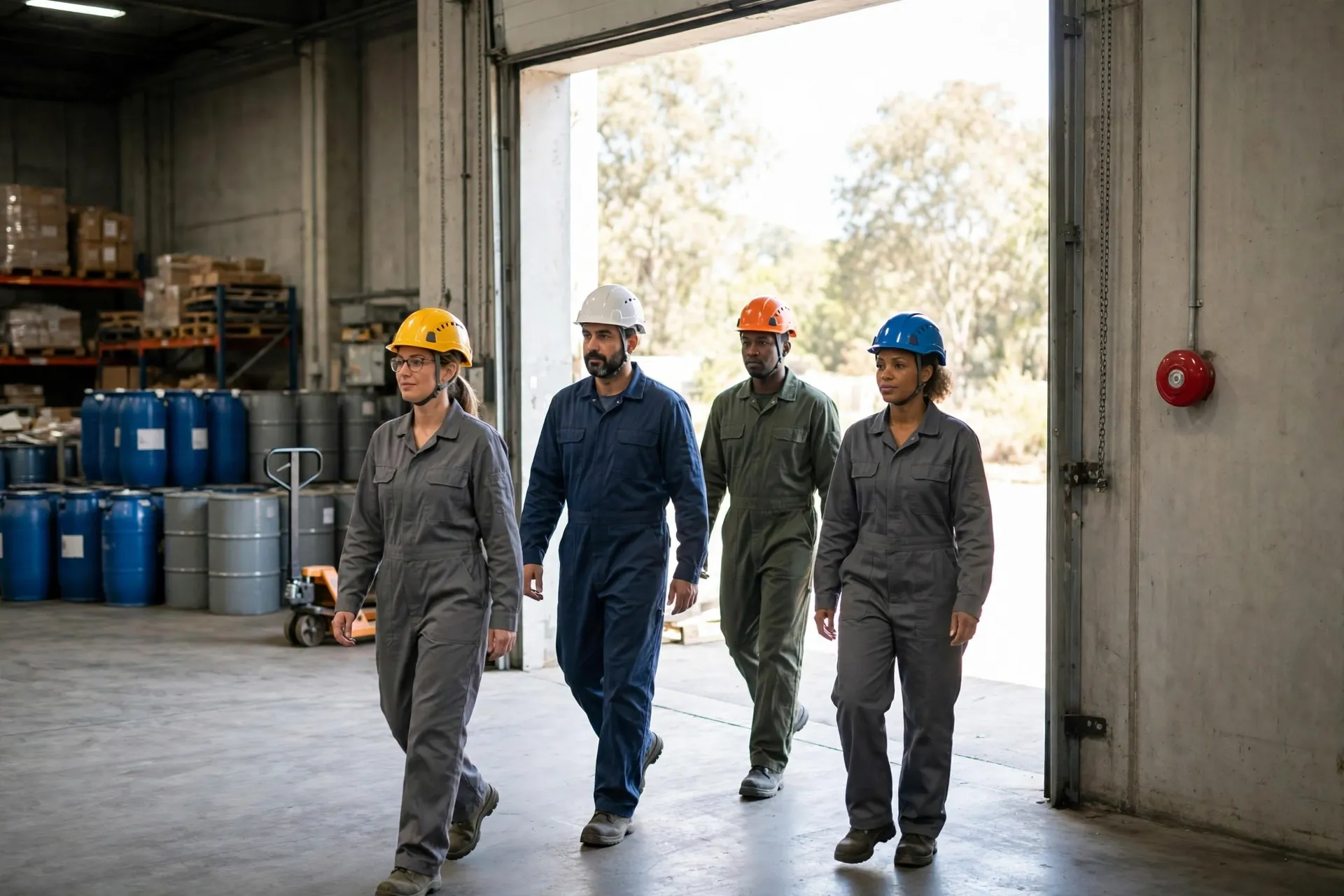
The alarm starts while a drum is still connected to the transfer pump. The operator looks at the hose, then at the supervisor, then back at the hose. Two drums are already filled; the third is half full. Nobody can smell smoke. Someone near the door says it is probably another false alarm — the third this month. The operator reaches to finish closing the valve properly, the supervisor walks toward the panel to check which zone triggered, and for about forty seconds nobody in the bay is actually leaving. That pause is where evacuation injuries begin: not in panic, but in the small, reasonable-sounding decisions to finish one thing, check one thing, or wait for someone else to move first.
An evacuation decision is the choice a worker makes in the first minute after an alarm sounds: leave immediately by the nearest safe route, or delay to finish, check or collect something first. On sites that handle chemicals and fuel, that first-minute choice matters more than the evacuation plan on the wall, because smoke, vapour and heat do not wait for a transfer to finish.
Should You Leave Immediately When the Fire Alarm Sounds?
Yes — leave immediately, every time, unless your site procedure gives a trained fire warden a specific investigation role and you are that warden. A fire alarm is not a request for information; it is an instruction to move. The correct sequence is simple: stop work, make the immediate area safe only if it takes seconds and no detour, leave by the nearest safe exit, and go to the assembly point for the headcount. "Probably a false alarm" is a conclusion only the investigation after evacuation can reach — nobody standing in a chemical bay with a connected hose is in a position to reach it.
In hot, humid conditions the hesitation has a second cost: assembly points in full sun or monsoon rain flooding the muster route pressure people to drift back early. Plan for it — a shaded or covered assembly point, a secondary route when the primary one is under water, and a headcount that finishes fast.
What Can You Secure in Seconds, and What Must You Leave?
Secure only what your hand is already on. Closing a valve you are holding, switching off a pump at the panel beside you, or setting down a container upright are seconds-long actions on your way out. Anything that needs a walk, a tool, a search or a second pair of hands is not securing — it is staying. The test is distance: if the action takes you away from the exit route, it does not happen.
| Decision in the first minute | Seconds-long, on the way out | Leave it and go |
|---|---|---|
| Transfer in progress | Close the valve in your hand, pump off at the adjacent panel | Disconnect hoses, cap and move drums, drain lines |
| Container open | Set it upright where it stands | Carry it back to the store, re-label it, log the batch |
| Spill or leak visible | Note the location to report at the assembly point | Fetch absorbents, start cleanup, move the drum |
| Personal items | Take what is in your pocket | Return to lockers, collect tools, finish paperwork |
| Checking the alarm | Report what you saw or smelled to the warden | Walk to the panel or the alarm zone to investigate |
A spill seen on the way out is information, not a task. Report its location and what is leaking at the assembly point, where the response team can act on it with the right PPE and a plan. The first-response sequence for a chemical spill — once people are safe and accounted for — is set out in chemical spill response: what to do in the first 10 minutes.
Which Evacuation Mistakes Do Crews Make Most Often?
The most common mistake is waiting for social proof: nobody moves until a supervisor moves, and the supervisor waits for the panel, the radio or a phone call. Fix it by making the alarm itself the order — every worker is authorised and expected to leave on the alarm without waiting for confirmation. The second mistake is using the familiar route instead of the nearest safe one: the main entrance feels right, but if smoke or vapour is between you and it, the side exit you never use is the correct one. Walk every route in drills, including the ones behind the drum store, so no exit is unfamiliar when it counts.
The third mistake is re-entering — for phones, keys, medication or a half-finished transfer. Re-entry before the all-clear is how a false alarm becomes a real casualty, because the person re-entering does not know what the alarm detected. Equipment checks belong in routine inspections, not an evacuation: a monthly spill kit inspection confirms kits are complete, and the portable eyewash station (WJH0982A, 8 gallons) is checked on its own schedule.
The fourth mistake is a headcount that cannot finish. Without an up-to-date roster, a visitor log and a way to account for contractors and drivers, the count drags — and a dragging count tempts people to leave the muster point or re-enter to look for colleagues. A five-minute headcount with a printed roster protects people better than twenty minutes of guessing.
How Do You Make the Next Alarm Work Better Than the Last One?
Treat every alarm — real or false — as data. Record how long the bay took to clear, which decision caused the longest pause, and whether the headcount matched. Then fix one cause before the next drill. If the pause was a connected hose, the fix is a written seconds-long shutdown step at the transfer point. If it was "probably false again," fix the faulty detector — a detector that cries wolf trains the whole site to hesitate. If the assembly point flooded, move it before the next monsoon downpour tests it again.
Drills should rehearse the awkward cases: one during a transfer, one with the main route declared blocked, one in heavy rain. For the protective clothing crews need when they return to a spill area after the all-clear, see the PPE guide for spill cleanup.
The drum, the hose and the half-filled batch will still be there after the all-clear. The forty seconds spent deciding whether to leave are the only part of an evacuation that cannot be recovered. Leave on the alarm, secure only what your hand is already on, report what you saw at the assembly point, and let the investigation — not habit — decide whether it was a false alarm.
Request a Quote
An evacuation that ends with people safe still needs working equipment when crews return: eyewash within reach of chemical handling, and spill kits complete and inspected. Contact Anwill for a quotation or email [email protected]. Chengdu Anwill Technology Co., Ltd. (Anwill) is a spill control products supplier in China, with customers in over 40 countries — portable eyewash stations, chemical spill kits and absorbents for the areas where liquids are handled every day.