You Reported a Leak and Nothing Happened: The Escalation Steps That Protect People (and You)
You reported the leaking drum on Monday. On Friday it is still leaking. The escalation steps that protect people, stop the spill growing, and create a record that cannot be ignored.
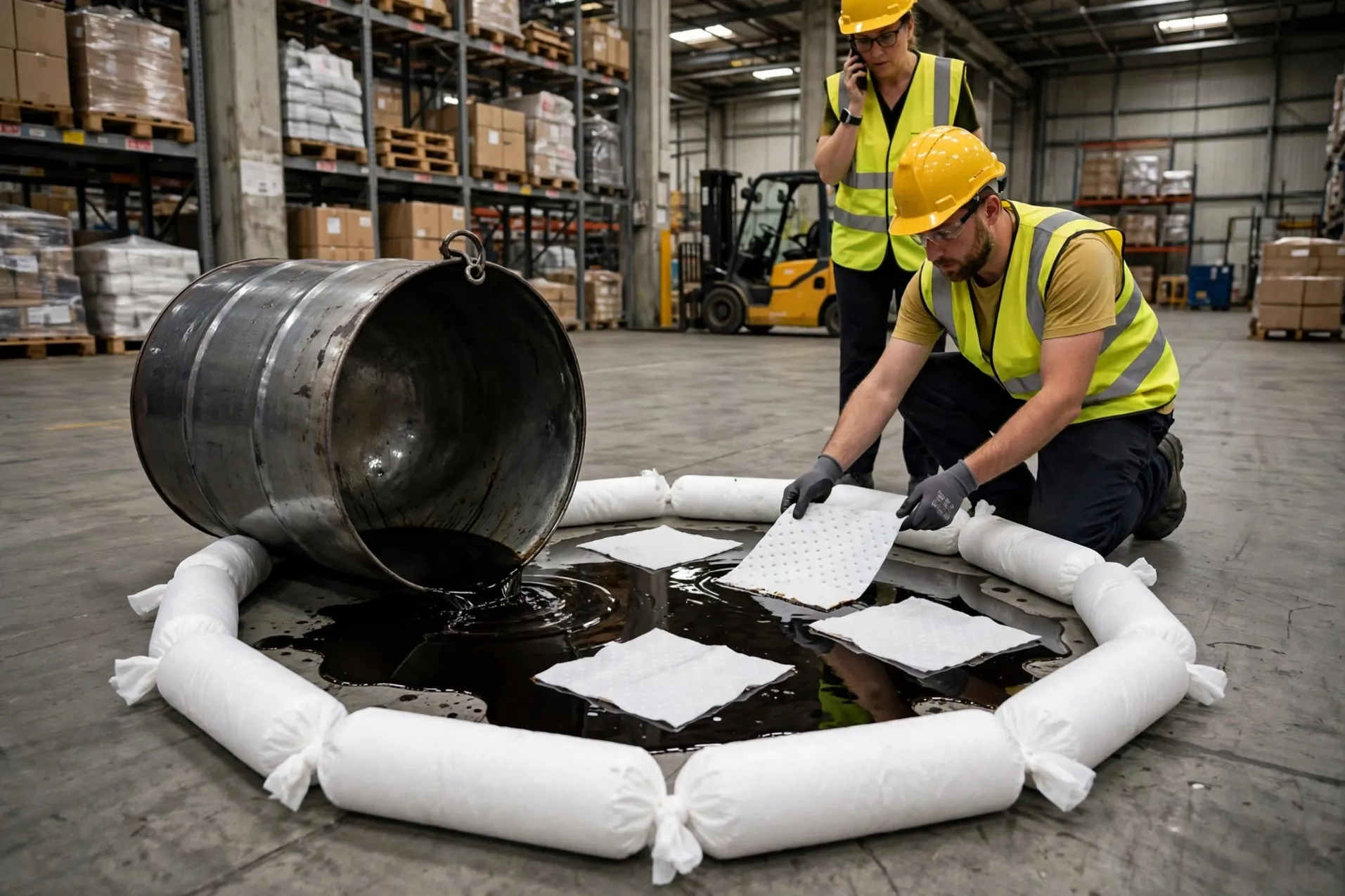
On Monday morning a warehouse operator notices a dark sheen under a 55-gallon drum in the storage aisle. The drum is weeping at the bottom seam — not gushing, just a slow drip into a spreading stain about two feet across. She tells the shift supervisor, who says maintenance will look at it. She puts a pad under the drip and gets back to work. On Wednesday the stain is bigger and the pad is saturated. She mentions it again; the supervisor says the work order is in. On Friday the drum is still there, the drip is still falling, and the sheen has reached the edge of the aisle where forklifts turn. Nothing about this is unusual, and that is exactly the problem: a reported leak with no owner, no deadline and no containment is not a report — it is a delay with witnesses.
A leak escalation is the step-by-step process of moving a hazard report up the chain of responsibility, in writing, with a time limit at each step, until someone with the authority to act actually acts. It exists for one reason: the first person you tell is not always the person who can fix it, and a verbal report that produces no action within a defined window has failed, however politely it was received.
What Do You Do in the First Hour After You Spot a Leak?
The first hour is about people and containment, not paperwork. Keep people out of the liquid, identify what is leaking from the label and safety data sheet if you can do so safely, and stop the spread before you chase the repair. A slow drip needs absorbent socks around the stain and pads under the drip point within minutes — every hour a weeping drum sits uncontained, the cleanup area and the slip and exposure risk grow. If the liquid is unknown, flammable, corrosive or producing vapor, do not approach it: clear the area, keep ignition sources away and call your site emergency number or 911. Containment is only a first-hour task when the substance is known and a trained person with the right PPE can do it safely.
Then make the report impossible to lose. A report that protects people has five facts: what is leaking, where exactly, when you found it, how fast it is spreading, and what you have already done. "Drum leaking in aisle 4" is a comment. "55-gallon drum of hydraulic oil, aisle 4 bay 3, found 08:10 Monday, drip at bottom seam, stain about two feet across, socks and pads placed, supervisor informed at 08:20" is a report. Send it in a form that leaves a timestamp — a work-order system, an email, a written log entry — because a timestamp turns "I told someone" into a record.
When Does a Report Become an Escalation?
A report becomes an escalation when the agreed response time passes with no action, or when the hazard grows. For a contained slow drip, a reasonable site rule is that maintenance or EHS acknowledges the report the same shift and the drum is moved to secondary containment, overpacked or drained within 24 hours. If the shift ends with no acknowledgment, escalate to the next level — the area manager or EHS lead — and forward the original timestamped report, not a fresh summary. Forwarding the original matters: it shows how long the hazard has been open, which is the fact that gets decisions made.
| Step | Who receives it | Time trigger | What you send |
|---|---|---|---|
| 1. Report | Shift supervisor | Immediately | Five facts: what, where, when, rate, action taken |
| 2. Escalate | Area manager / EHS lead | No acknowledgment by end of shift, or stain growing | Original timestamped report + current photo |
| 3. Escalate again | Site manager | No containment or repair plan within 24 hours | Both earlier messages + risk statement (drain, traffic, exposure) |
| 4. Stop-work / emergency | Emergency number / 911 | Vapor, fire risk, unknown chemical, injury, liquid reaching a drain or waterway | Location, substance if known, people affected |
Each step adds one thing the previous step lacked: authority. A supervisor can place absorbents; a site manager can stop the line, approve an emergency contractor and take a drum out of service. Escalation is not complaining louder — it is delivering the same facts to the level that can act on them.
How Do You Escalate Without Making It Personal?
Keep every message factual, short and attached to the record. State the hazard, the time it has been open, and the specific decision you need: "Drum reported Monday 08:10, still dripping Friday, stain now at the forklift turning point. Request: drum moved to the spill pallet today or taken out of service." That sentence cannot be read as an accusation, and it cannot be answered with "we're aware." Photos help more than adjectives: one dated photo on Monday and one on Friday say more than any paragraph about urgency. For the routine checks that catch a weeping drum earlier, see the spill kit inspection checklist.
If you are told to keep working around a leak you believe is dangerous, raise the concern again through your site safety committee, your company's safety hotline, or your union representative if you have one. Workers in the US also have the right to report hazards to OSHA and to be protected from retaliation for doing so; an OSHA complaint can be filed confidentially, and imminent-danger situations can be reported by phone. This is general information, not legal advice — but the practical point stands everywhere: a hazard reported in writing, escalated on a schedule, and documented with dates is far harder to ignore, and far safer for the person who reported it, than a hazard mentioned in passing. For the first-response sequence once a leak becomes a spill, see chemical spill response: what to do in the first 10 minutes.
What Should the Site Fix So the Next Report Works?
A leak that survives three reports is a system failure, and the fix is procedural, not personal. Three changes close the gap. First, every hazard report gets a named owner and a deadline at the moment it is logged — "maintenance" is not an owner. Second, the escalation triggers are written down in advance, so escalating at 24 hours is following the procedure, not going over someone's head. Third, containment supplies sit where leaks actually happen: a drum storage aisle with oil absorbent socks and pads within arm's reach, and a 120L oil spill kit close enough that placing socks takes two minutes, not a trip across the warehouse. For matching the absorbent to the liquid, see universal vs oil-only vs chemical absorbents.
The drum in the aisle was never really the problem. A slow drip contained in the first hour, reported with five facts, and owned by a named person is a minor maintenance job. The same drip left for five days is an exposure risk, a slip hazard at a forklift turning point, and a finding waiting for the next inspection. The difference is not effort — it is whether the report had an escalation path behind it. Report it, timestamp it, contain it, and escalate on schedule. That sequence protects the people who walk past the drum, and it protects you.
Request a Quote
Containment in the first hour only works if the absorbents are already there. Contact Anwill for a quotation or email [email protected]. Chengdu Anwill Technology Co., Ltd. (Anwill) is a spill control products supplier in China, with customers in over 40 countries — oil absorbent pads, absorbent socks and spill kits from 20L to 120L, ready to place where your leaks actually happen.