Your SDS Platform Doesn't Work on the Floor? A Practical Fallback System
The SDS app wants a login, the kiosk is in another building, and a drum is leaking. A fallback system — binder, spill cards and QR codes — that keeps safety data sheets reachable on the floor.
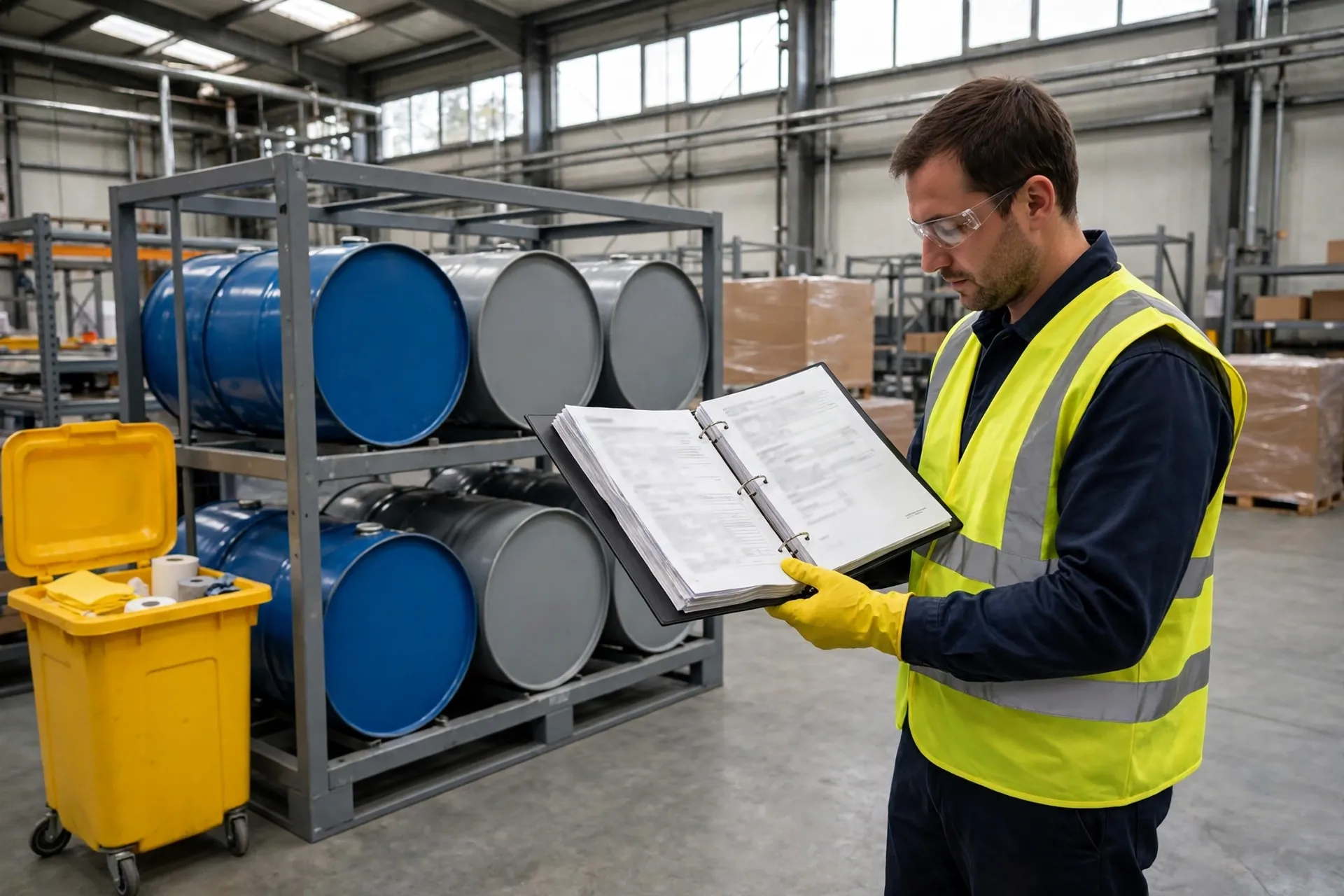
A forklift clips a 55-gallon drum on the rack in the chemical store. The bung cracks and a thin stream of solvent runs across the concrete toward the aisle. The operator stops the forklift, steps back, and reaches for the safety data sheet — before anyone touches that liquid, someone has to know what it is and what gloves it needs. He opens the SDS app on the shared tablet. It wants a login. The password expired last month and nobody wrote down the new one. The kiosk in the office is a three-minute walk away, and the warehouse Wi-Fi drops out halfway down the aisle. The liquid is ten feet from the floor drain. That is the moment a safety data sheet system fails — not in an audit, but on the floor, with a spill spreading.
A safety data sheet (SDS) is a 16-section document that describes a chemical's hazards, the protective equipment it requires, first aid, fire-fighting measures and how to clean up a spill. Under OSHA's Hazard Communication Standard (29 CFR 1910.1200), SDSs must be readily accessible to employees during each work shift, in their work areas. "Readily accessible" is the whole test: a system that needs a password nobody remembers, a computer in another building, or a signal that dies in the warehouse is not readily accessible in practice.
Why Do SDS Platforms Fail on the Floor?
They fail in four predictable ways. The first is access: a login, a license seat, or a single shared tablet charging in the office when it is needed at the rack. The second is signal: metal racking and concrete walls are dead zones, and a cloud platform is a blank screen without a connection. The third is search: the worker searches the trade name on the drum and the platform lists the chemical under a different name, so the sheet never surfaces. The fourth is distance: the terminal sits at the supervisor's desk while the spill is at the far end of the store, and nobody walks away from a spreading liquid to read a screen.
What Does a Practical Fallback System Look Like?
A fallback system is not a rejection of the digital platform; it is the layer underneath it that works when the platform does not. It has three layers, and a site needs all three, because each one covers a failure the others cannot.
| Layer | What it is | What failure it covers | Where it lives |
|---|---|---|---|
| The binder | Printed SDSs for every chemical in that store, in one ring binder | No login, no signal, no power | On the rack, at arm's reach from the drums |
| The spill card | One page per chemical family: PPE, first aid, cleanup steps, emergency number | Nobody has time to read 16 sections while liquid spreads | Taped inside the spill kit lid and on the rack end |
| The QR code | A code on each rack bay linking to the SDS, plus an offline copy on a shared drive | The binder is out of date or the sheet is missing | On the rack label; offline file on the supervisor's laptop |
The binder is the backbone: one per chemical store, not one for the whole site, with the sheets in the same order as the drums on the rack and a tab per chemical family, so the right sheet is found in under a minute. The spill card is the fast version: the four things a responder needs — Section 8 for gloves and goggles, Section 4 for first aid, Section 6 for cleanup, and the emergency number. The QR code is the bridge back to the platform: it takes a phone straight to the current sheet, backed by an offline copy updated at the same time as the platform.
How Do You Keep the Binder Honest?
A binder that is out of date is worse than no binder, because it gives a wrong answer with confidence. The fallback system only works if one named person owns it — not a department. The rule is simple: a new chemical does not go on the rack until its SDS is in the binder and its spill card is written. No sheet, no shelf space. That one rule stops the binder drifting out of step with the store, because the gap is caught at the receiving dock instead of at the spill.
The second rule is a quarterly check that takes twenty minutes: the owner walks the rack, matches every drum to a sheet in the binder, and pulls any sheet for a chemical no longer on site. Old sheets go in an archive folder, not the bin. The third rule is a drill, twice a year: pick a drum at random and time how long it takes a worker to find its sheet and read off the glove material. More than two minutes means the system is broken, and the fix is usually small — a missing tab, a binder that migrated to the office, a card that fell off the rack.
What Do You Do in the First Two Minutes?
The spill does not wait for the paperwork, so the fallback system is built around a two-minute sequence. First, identify the chemical — the drum label, not a guess — and find its sheet or its spill card. Second, read Section 8 and put on the PPE it names before touching anything: gloves and goggles before absorbents, always, because a glove that resists oil may not resist a solvent. The guide to which gloves, goggles and protective clothing to wear for a spill covers glove materials and the order to put them on. Third, contain: ring the liquid with absorbent socks, block the drain, and only then start mopping up — the first 10 minutes of a chemical spill decide whether it stays on the floor or reaches the drain.
That sequence only works if the kit is next to the binder. A 120L chemical spill kit in a wheeled bin belongs in the chemical store itself, sized to the largest container in the room: 75 pads, 4 socks, 5 pillows, two pairs of gloves and two pairs of goggles, plus disposal bags. A 20L chemical spill kit in a carry bag belongs where a spill would be small and the responder is one person — a bench, a laboratory, a service vehicle. A store that holds 55-gallon drums and stocks only a 20L kit has planned for a leak, not a drum. The kit needs the same discipline as the binder: a monthly spill kit inspection catches used-up gloves and missing socks before the spill does. And if the drum that leaked was missing its label, the sheet cannot be found at all — unlabeled containers are the HazCom mistake inspectors catch first.
The platform is still the system of record — current sheets, revision dates, audit trail — and it should stay. But a system of record is not a system of response. The binder, the spill card and the QR code are what the worker actually reaches for with liquid on the floor. The next time the app asks for a login it does not have, the answer should already be on the rack.
Request a Quote
A chemical store is only ready when the kit is next to the information. Contact Anwill for a quotation or email [email protected]. Chengdu Anwill Technology Co., Ltd. (Anwill) is a spill control products supplier in China, with customers in over 40 countries — chemical spill kits from 20L to 120L, with gloves, goggles and disposal bags included, and the absorbent socks, pads and drain covers to keep a spill on the floor and out of the drain.