Unlabeled Containers: The HazCom Mistake Inspectors Catch First
An inspector stops at a row of unlabeled jugs — and the citation starts there. What OSHA HazCom requires on secondary containers, and the labeling routine that keeps a site clean.
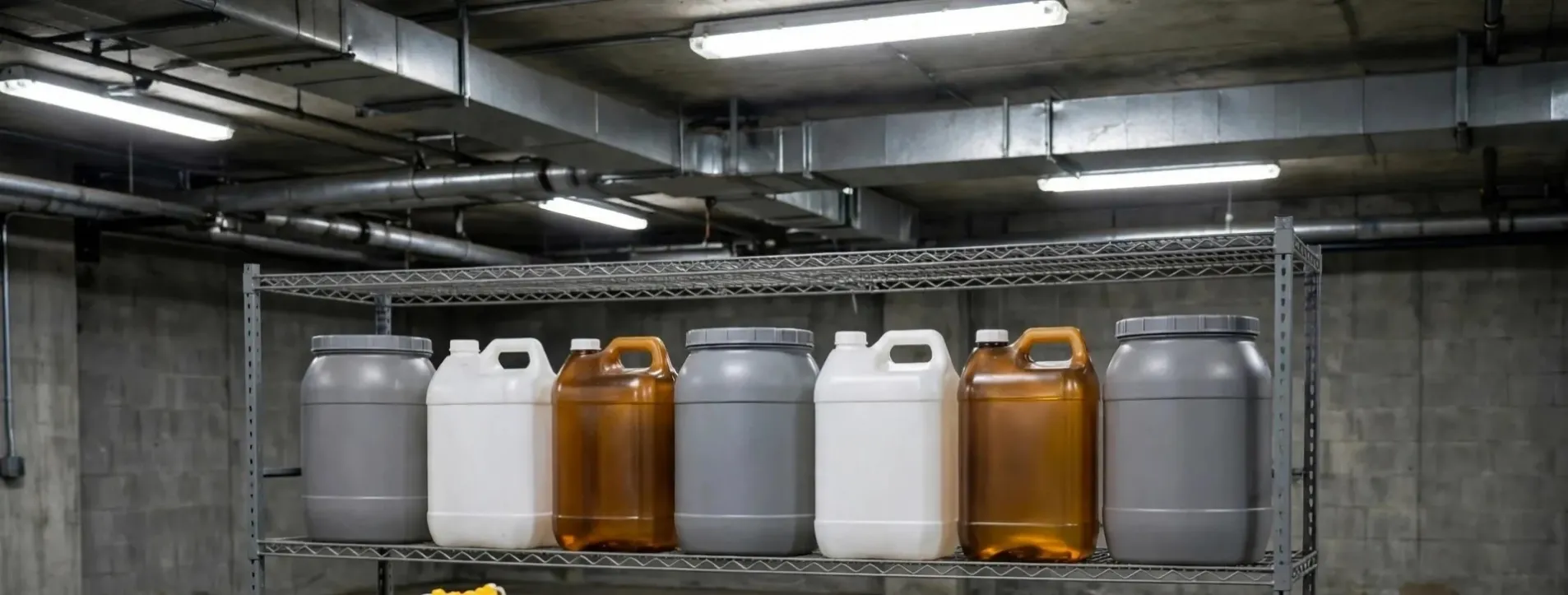
It is late afternoon at a chemical distribution warehouse. A maintenance tech pumps degreaser from a 55-gallon drum into a small jug so he can carry it to a machine across the floor. His radio crackles, he sets the jug down on a workbench to answer it, and the job runs long. The jug sits there the rest of the shift — no label, no name, nothing to say what is inside it. The next morning a second-shift worker picks it up, assumes it is the water-based cleaner they use on the same bench, and tops up a parts washer with it. Nothing explodes. Nothing catches fire. But the parts washer now holds the wrong chemical, nobody on the floor can say what it is, and the jug has already failed the first test any inspector applies when they walk into a building.
A secondary container is any container a chemical is poured into after it leaves the container it was shipped in — a spray bottle, a jug, a bucket, a drum split into smaller lots. The moment a chemical leaves its original container, the label that travelled with it stays behind, and the new container starts its life with no identity at all. That is the gap inspectors look for first, because it is visible from the aisle and it takes no testing to prove.
What does OSHA require on a secondary container?
Under the Hazard Communication standard, 29 CFR 1910.1200(f)(6), every container of hazardous chemicals in the workplace must be labeled with the product identifier and with words, pictures, symbols, or a combination of these that give general information about the chemical's hazards. The container it was shipped in carries the full GHS label — product identifier, signal word, hazard statements, pictograms, precautionary statements, and supplier identification — and the workplace container must carry enough of that information for anyone who picks it up to know what it is and what it can do to them.
OSHA does not demand a full GHS label on every jug and spray bottle. A workplace labeling system such as the NFPA diamond or the HMIS label is acceptable, as long as employees are trained to understand it and it conveys the product identity and the hazard. What is never acceptable is a blank container. The rule is simple to state and easy to fail: if a worker cannot tell what is in a container by looking at it, the container is out of compliance.
Why unlabeled containers are the first thing an inspector checks
Hazard Communication is one of the most-cited OSHA standards year after year, and the labeling violation is the easiest one to find. An inspector does not need a meter, a sample, or a document request — they walk the floor, open a cabinet, and look. A row of unlabeled jugs tells them, before a single question is asked, that the site's HazCom program has a hole in it. Each unlabeled container can be cited as its own violation, so a shelf of five blank jugs is five citations, not one.
It also signals what the inspector will look for next. If labels are missing, the safety data sheets are often hard to reach, the training records are often thin, and the spill response supplies are often the wrong type for the chemicals actually on site. One visible gap invites a deeper look at the whole program. A site that labels everything, every time, usually has the rest of its HazCom house in order — and the inspector can see that from the aisle too.
The three ways an unlabeled container causes real harm
First, the wrong chemical in the wrong place. Pour an acid-based descaler into a jug that still holds bleach residue, and the mixture can release chlorine gas. Top up a parts washer with a solvent-based degreaser that was meant for a water-based cleaner, and the next worker to use it is handling a flammable liquid they were never told about. The label is the only thing standing between the person who poured it and the person who picks it up next.
Second, the wrong first aid. A splash in the eyes is a fifteen-minute eyewash flush — but which eyewash, and what does the safety data sheet say about that chemical? If nobody knows what splashed, the crew loses the first minutes to guessing, and the first minutes are the ones that decide whether an eye injury is a rinse or a hospital visit. A portable eyewash station only works fast when the crew already knows what they are flushing out.
Third, the wrong spill response. A jug tips off a bench and the crew grabs the nearest kit — but oil-only pads will not touch a chemical spill, and a chemical spill kit is wasted on oil. When the container is labeled, the crew reads it, checks the safety data sheet, and reaches for the right kit. When it is blank, they guess, and guessing is how a small spill becomes a reportable one. The first 10 minutes of a chemical spill are decided by knowing what spilled, and that knowledge starts with the label.
The labeling routine that actually sticks
Label at the moment of transfer, not later. The person who pours the chemical labels it, before they walk away — "later" is how jugs end up blank, because the person who poured it is the only one who knows what is in it, and their memory leaves with them at the end of the shift.
Put four things on the label at minimum: the product name exactly as it appears on the safety data sheet, the hazard pictogram or signal word, the date it was decanted, and the initials of the person who poured it. The date matters — decanted chemicals age, and a jug poured six months ago may no longer match the stock on the shelf.
Never use food or drink containers. A chemical in a water bottle is a poisoning waiting for a thirsty worker, and it is also a citation on its own. Keep a stack of pre-printed blank labels at every decanting point, next to the drum pump, so labeling takes ten seconds and skipping it takes a deliberate decision. Then add a weekly walk: a supervisor checks every secondary container on the floor, and anything unlabeled is quarantined on the spot — labeled if it can be identified, disposed of as hazardous waste if it cannot.
| Label element | Shipped container (full GHS label) | Secondary container (workplace label) |
|---|---|---|
| Product identifier | Required, matches the SDS | Required, matches the SDS |
| Signal word (Danger / Warning) | Required | Required, or conveyed by the workplace system |
| Hazard pictograms | Required | Required, or conveyed by the workplace system (e.g. NFPA diamond) |
| Hazard and precautionary statements | Required | Recommended; the SDS must be accessible |
| Supplier identification | Required | Not required |
| Date decanted and who poured it | Not applicable | Recommended practice — shows the contents are current |
What to do when you find one
Quarantine it first. Move the unlabeled container to a marked holding area and do not use it, pour from it, or pour it back into the original drum — pouring an unknown liquid back into a drum can contaminate the whole drum. Identify it from the stock list, the decanting log, or the person who poured it. If it can be identified with confidence, label it properly and return it to service. If it cannot be identified, treat it as hazardous waste and dispose of it through the site's hazardous waste route — never sniff it, never taste-test it, and never guess from the smell. An unknown chemical costs a disposal fee; a wrong guess costs far more.
An unlabeled container is the cheapest violation in the building to fix and the most expensive one to ignore. Ten seconds with a label at the moment of transfer is the whole system — everything after that, from the eyewash to the spill kit to the inspector's report, depends on it.
Request a Quote
A chemical store that labels everything still needs the right kit behind the label: a 120L chemical spill kit for a chemical store or decanting point, a 20L chemical spill kit for a bench or a small store, and the spill kit guide to size the rest. Read the PPE guide for spill cleanup so the crew reaching for the kit is wearing the right gloves and goggles for the chemical they just identified. Contact Anwill for a quotation, or email [email protected]. Chengdu Anwill Technology Co., Ltd. (Anwill) is a spill control products supplier in China, with customers in over 40 countries — chemical spill kits from 20L to 660L, portable eyewash stations, and the absorbent socks, pads and drain covers to keep a spill on the floor and out of the drain.
Even a perfectly labelled store still needs the SDS within reach — see how a fallback system keeps safety data sheets reachable on the floor.