How Much Spilled Chemical Must You Report? Reportable Quantities Explained
A drum tips at the dock and the crew cleans it up in twenty minutes — but was it reportable? US reportable quantities, the sheen rule and the SPCC thresholds, explained.
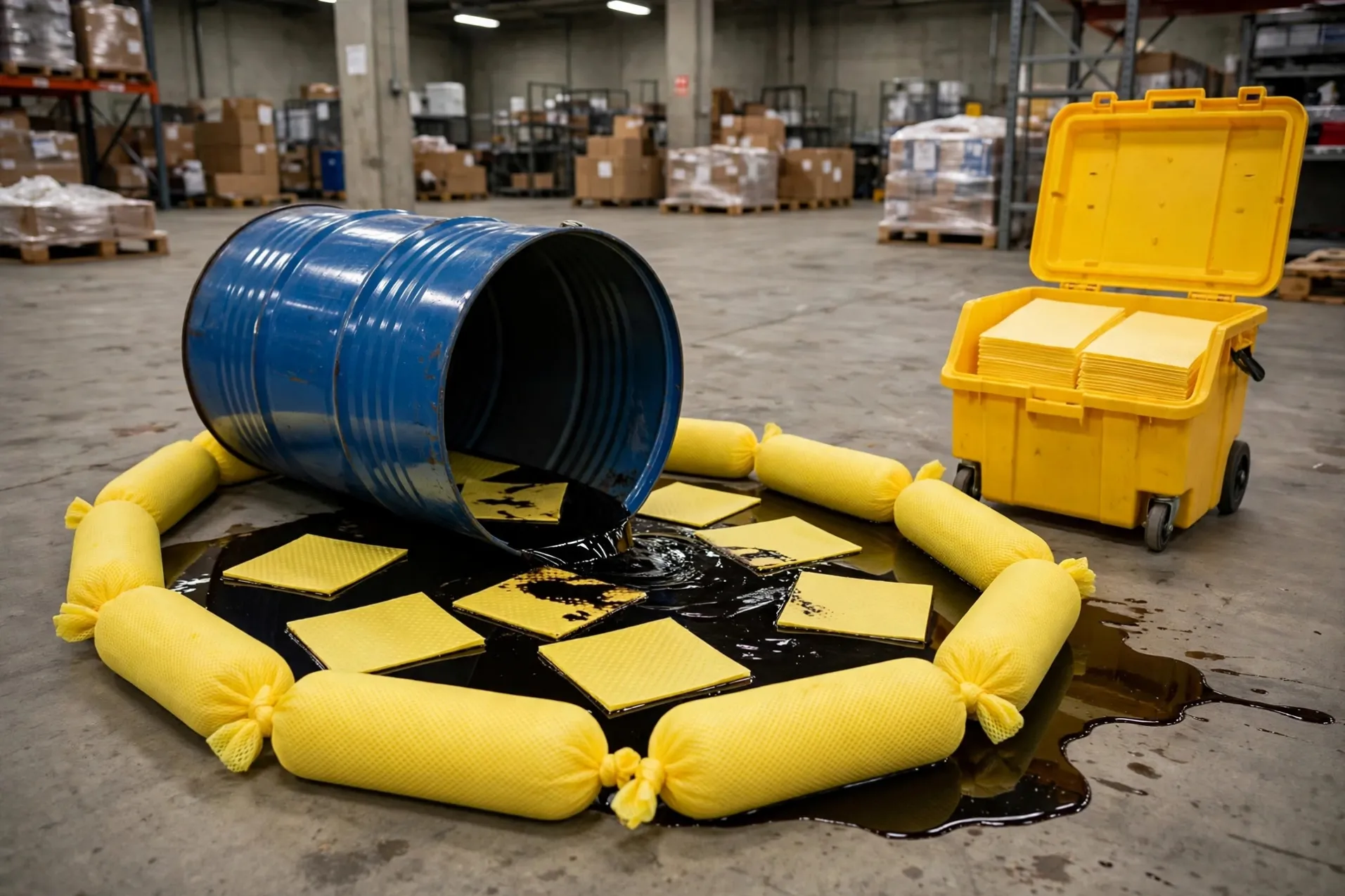
It is just after midnight at a chemical distribution warehouse. A forklift driver turns too tight at the end of a racking aisle and clips a 55-gallon drum of solvent-based cleaner standing on a pallet at the dock door. The drum tips, the bung cracks, and about 15 gallons spread across the dock floor. The crew does everything right: they ring the spill with absorbent socks, throw pads on the liquid, and bag the used absorbents. Twenty minutes later the floor is dry. Then the shift supervisor asks the question nobody on the crew can answer: do we have to report this?
A reportable quantity (RQ) is the amount of a listed hazardous substance that, released into the environment within any 24-hour period, triggers a legal duty to tell the authorities. In the United States that duty comes from two laws — CERCLA, the federal Superfund law, and EPCRA, the Emergency Planning and Community Right-to-Know Act — and the answer is never one single number, because every substance has its own RQ.
How do you find the reportable quantity for what you spilled?
Look it up by substance, in pounds. RQs for CERCLA hazardous substances are listed in Table 302.4 of 40 CFR 302.4, and RQs for EPCRA extremely hazardous substances (EHS) in Appendices A and B of 40 CFR 355. The values are 1, 10, 100, 1,000 or 5,000 pounds — set per substance, by hazard, not by container size. EPA's Consolidated List of Lists brings both lists together in one place.
A reportable quantity is set per substance, not per spill: the same 15 gallons can be a routine cleanup for one chemical and a federal report for another, because RQs range from 1 pound to 5,000 pounds depending on the substance. That is why the first thing to check after any spill is the identity of the chemical, not the size of the puddle. Do the arithmetic in pounds, not gallons: a full 55-gallon drum of a water-based liquid weighs about 460 pounds, so if that liquid's RQ is 100 pounds, spilling a quarter of the drum already crosses the line. Keep a printed RQ card for every chemical you store in bulk — name, RQ in pounds, and roughly how many gallons that RQ equals — so the crew can read the answer off a card instead of doing the maths at 1 a.m.
Who do you call, and how fast?
Immediately — as soon as you know the release is at or above the RQ. For a CERCLA hazardous substance, the call goes to the National Response Center at 1-800-424-8802, staffed around the clock by the U.S. Coast Guard. Under EPCRA Section 304, you must also notify the State Emergency Response Commission (SERC) and the Local Emergency Planning Committee (LEPC) for any area likely to be affected. A written follow-up report then goes to the SERC and LEPC as soon as practicable — states typically expect it within about 30 days.
Have this ready before you dial: the chemical name and whether it is an extremely hazardous substance, your best estimate of the quantity released and how you estimated it, the time and duration of the release, the medium it went into — air, water, soil, a floor drain — and what you have already done about it. Do not delay the call to get every number exact; a late call is worse than an approximate one.
Oil follows a different rule: the sheen rule
Oil does not wait for a reportable quantity. Under the Clean Water Act and 40 CFR 110 — the "sheen rule" — any discharge of oil that violates water quality standards, causes a film or sheen on the surface of the water or adjoining shoreline, or deposits sludge or emulsion beneath the surface is a harmful quantity, and it must be reported to the National Response Center immediately at 1-800-424-8802.
For oil on water there is no minimum volume: if the discharge leaves a visible sheen, it is reportable, whether it is five gallons or five hundred. The rule covers petroleum and non-petroleum oils alike — vegetable oil counts too. A storm drain counts as a route to water: oil that reaches a drain leading to a waterway has reached navigable waters, even if nobody saw it touch a river. That is why the first move in any oil spill near a drain is a drain cover or absorbent socks across the drain, before the oil gets there.
SPCC adds its own numbers — for oil that reaches water
The Spill Prevention, Control, and Countermeasure (SPCC) rule, 40 CFR 112, adds a second, separate reporting duty for oil. It applies to facilities with more than 1,320 gallons of aboveground oil storage or more than 42,000 gallons buried, and it requires a report to the EPA Regional Administrator within 60 days when a discharge to navigable waters or adjoining shorelines is more than 1,000 U.S. gallons of oil in a single discharge, or more than 42 U.S. gallons of oil in each of two discharges occurring within any 12-month period.
Under SPCC, the number that matters is the oil that actually reaches the water — 1,000 gallons in one discharge, or 42 gallons in each of two discharges inside 12 months — not the volume that hit the floor. A 500-gallon spill fully contained on concrete triggers no SPCC report; a 50-gallon spill that runs down a drain into a creek can trigger one, if it is the second such discharge inside a year. Keep a running log of every oil discharge that reaches water, however small: the 42-gallon test is a 12-month test, and you cannot know whether this spill is the second one unless you can see the first.
The three reporting rules, side by side
| Rule | Applies to | Trigger | Who to tell | When |
|---|---|---|---|---|
| CERCLA §103 / EPCRA §304 | Listed hazardous substances and extremely hazardous substances | Release at or above the substance's RQ (1–5,000 lb) within 24 hours | National Response Center (CERCLA); SERC and LEPC | Immediately; written follow-up as soon as practicable |
| Clean Water Act §311 — "sheen rule" (40 CFR 110) | Oil, petroleum and non-petroleum | Any discharge causing a sheen, film, discoloration, sludge or emulsion on water | National Response Center, 1-800-424-8802 | Immediately |
| SPCC (40 CFR 112.4) | Oil at SPCC facilities | More than 1,000 gal in one discharge, or more than 42 gal in each of two discharges in 12 months, reaching navigable waters | EPA Regional Administrator | Within 60 days |
What to do in the first hour after a spill
Stop the source, then contain it. Upright the drum or close the valve, ring the liquid with absorbent socks, and cover any drain in its path before you start mopping up — a 120L chemical spill kit holds the socks, pads and disposal bags for exactly this job, and the first 10 minutes of a chemical spill decide whether it stays on the floor or reaches the drain.
Estimate the quantity honestly and write down how you got the number: "about 15 gallons from a tipped 55-gallon drum" is a defensible estimate; "not much" is not. Check the safety data sheet and the RQ list for that substance, in pounds. If the release is at or above the RQ — or if oil has reached water — make the call now, during the cleanup, not after it. Then keep the evidence: photos, times, quantities, who was called and when. The monthly spill kit inspection is the moment to check the kit is restocked and the RQ cards are still current.
Three mistakes that turn a small spill into a violation
First, assuming a cleaned-up spill does not count — reporting duties are about the release, not about whether you mopped it up. Second, guessing the quantity or the RQ instead of checking: "a 55-gallon drum" is not a quantity; the pounds that left the drum is. If nobody on the shift knows the substance's RQ, treat the spill as reportable until someone who does know says otherwise. Third, forgetting the state: federal RQs are the floor, not the ceiling, and many states require reporting at lower thresholds, or for any spill that leaves the property or reaches a drain. Write your state's number on the same card as the National Response Center number. Reporting is only half the job; the disposal route for the waste left behind still has to be documented and completed.
Request a Quote
The question to answer before the next spill is not "how big was it" but "what was it, and how many pounds left the container" — and the answer should be on a card, not in someone's head. Put the right kit at the point of risk: a 120L chemical spill kit for a chemical store or decanting point, a 20L chemical spill kit for a bench or a small store, and the spill kit guide to size the rest. Contact Anwill for a quotation, or email [email protected]. Chengdu Anwill Technology Co., Ltd. (Anwill) is a spill control products supplier in China, with customers in over 40 countries — chemical spill kits from 20L to 660L, and the absorbent socks, pads and drain covers to keep a spill on the floor and out of the drain.
That first check is the hardest one if the container was unlabeled — with no label there is no substance name, no RQ to look up, and no report to file until the chemical is identified.